
New Jersey Release Records
A release record marks the end or change of a particular custody episode. It does not always mean a person entered the community with no further legal control. Someone may leave a county jail on bond, after time served, by court order, or for transfer to NJDOC, another county, federal custody, or immigration custody. A person leaving a New Jersey prison may enter parole, mandatory supervision, a residential correctional placement, or final discharge. Each event points to a different record keeper.
The most reliable method is to name both the agency and the event. A county release transaction can show when local custody ended. An NJDOC incarceration history uses Date Out-of-Custody for the completed event. A State Parole Board record can show whether supervision followed. Court records can explain the judgment or later order, but they do not usually prove the exact time someone passed through a release gate. A vanished roster entry alone proves none of these details.
The official NJDOC website shows how statewide offender information is organized.
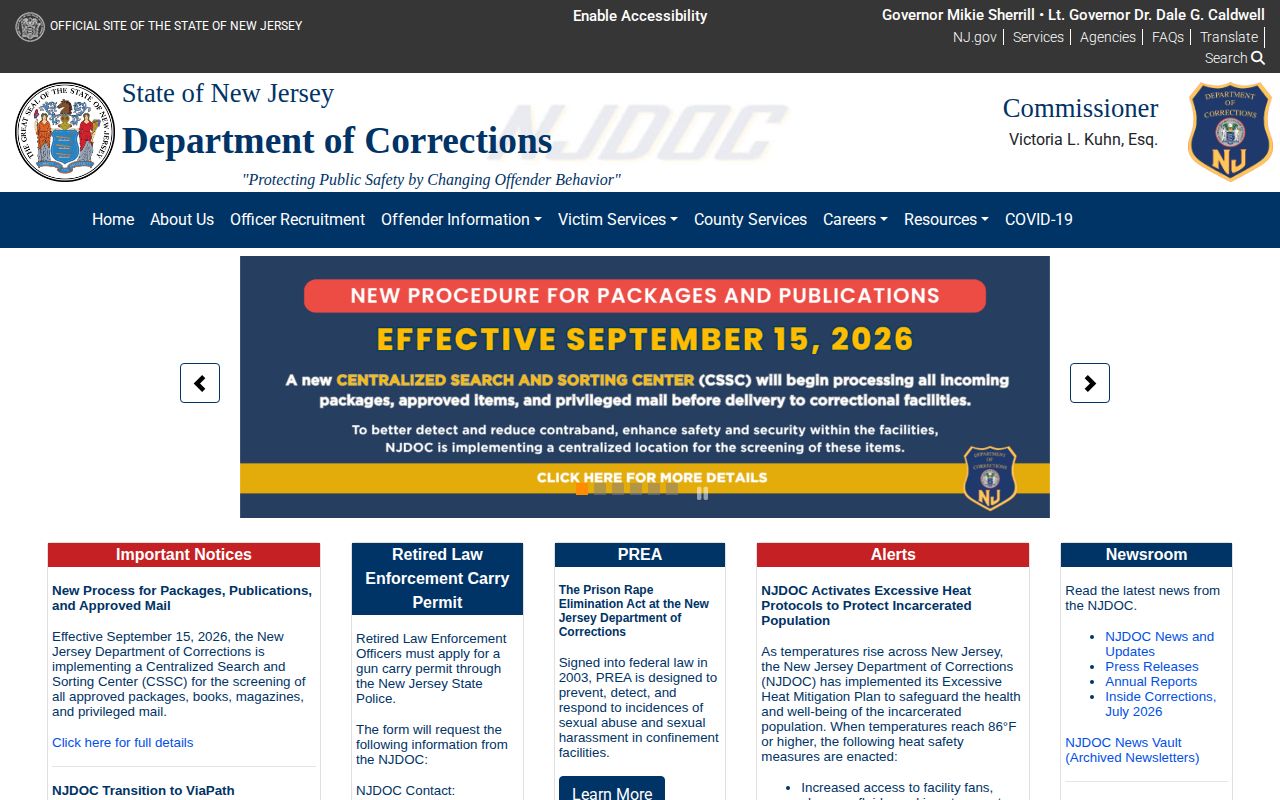
That statewide route applies to NJDOC custody, while county jail records remain with the county that maintained the episode.
Ways New Jersey Custody Ends
Several events are often called release, though their legal effects differ. Ordinary parole lets a person leave an institution before the maximum term while remaining under State Parole Board supervision. Administrative parole release operates under the Earn Your Way Out Act when its conditions are met. Some sentences lead to mandatory supervision after the required custody portion. Final discharge ends the applicable correctional or supervision term. A transfer ends one agency's physical custody but begins another's.
| Event | What changed | Best next record |
|---|---|---|
| County release | The local jail episode ended by bond, time served, order, or another local process | County release transaction and court docket |
| Transfer | One custodian released the person to another authority | Sending agency movement record and receiving agency locator |
| Parole or mandatory supervision | Physical custody ended while supervision continued | NJDOC history and State Parole Board record |
| Final discharge | The custodial or supervision term reached its legal end | Final certificate, order, or discharge record |
Important: A halfway house or Residential Community Reintegration Program is community based but remains a correctional placement, not an unconditional discharge.
These distinctions come from the NJDOC field definitions and New Jersey's parole statutes.
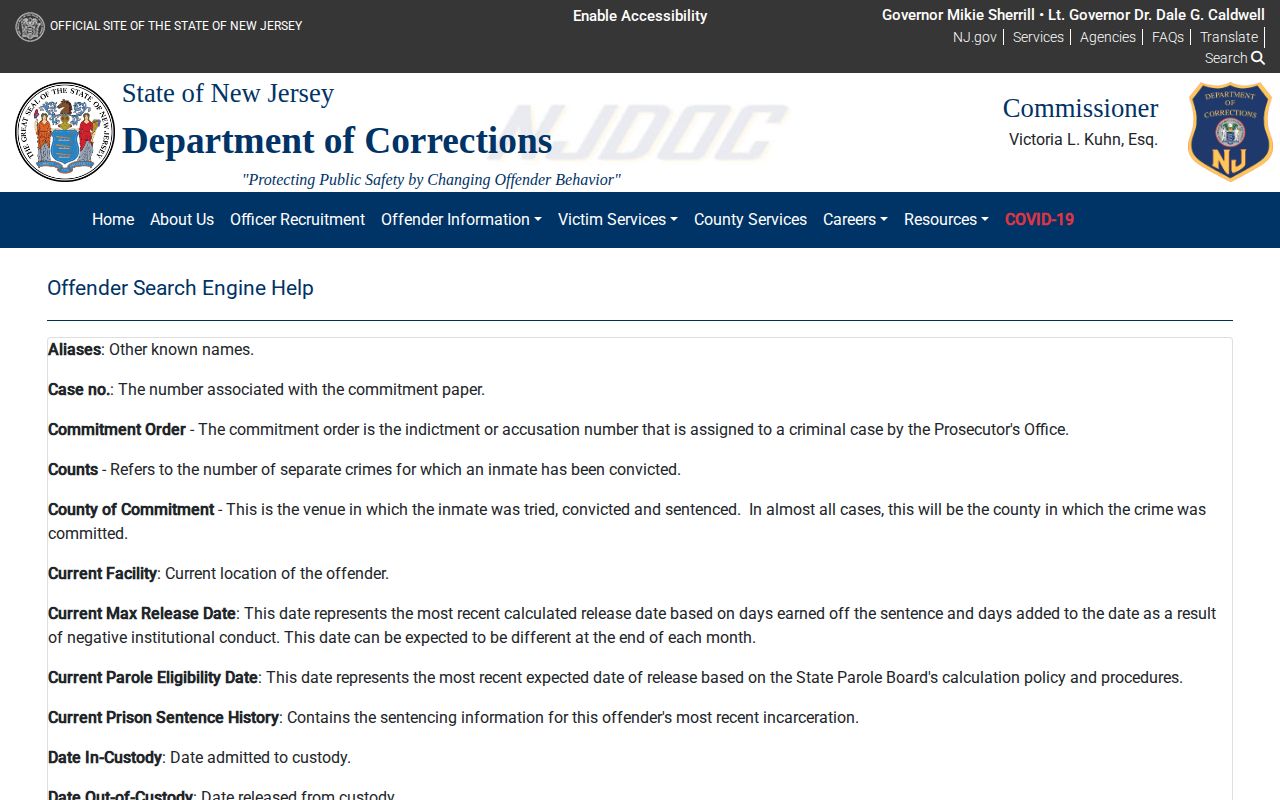
The agency's exact labels prevent a projected date or residential move from being reported as a completed release.
New Jersey Release Record Fields
A useful release record identifies the person, the custody segment, and the legal or operational event that ended it. County formats differ, but a focused request can seek the booking or admission identifier, admission date, release date and time if maintained, release type, authorizing case or order, releasing facility, and transfer or receiving authority category. NJDOC uses its own history and sentence fields, including the SBI number, Date In-Custody, Date Out-of-Custody, facility history, county of commitment, case number, and sentence data.
| Field | What it establishes |
|---|---|
| Name and SBI or booking number | Connects the record to the correct person and custody episode |
| Date In-Custody | Marks the start of the NJDOC history segment |
| Date Out-of-Custody | Marks the date NJDOC says the person was released from that custody segment |
| Release or transfer type | Separates community release, court release, parole, discharge, and transfer |
| Facility and county of commitment | Identifies the institutional and case geography |
| Supervision or final certificate | Shows whether legal control continued or ended |
The NJDOC offender search is the live entry point for state records.
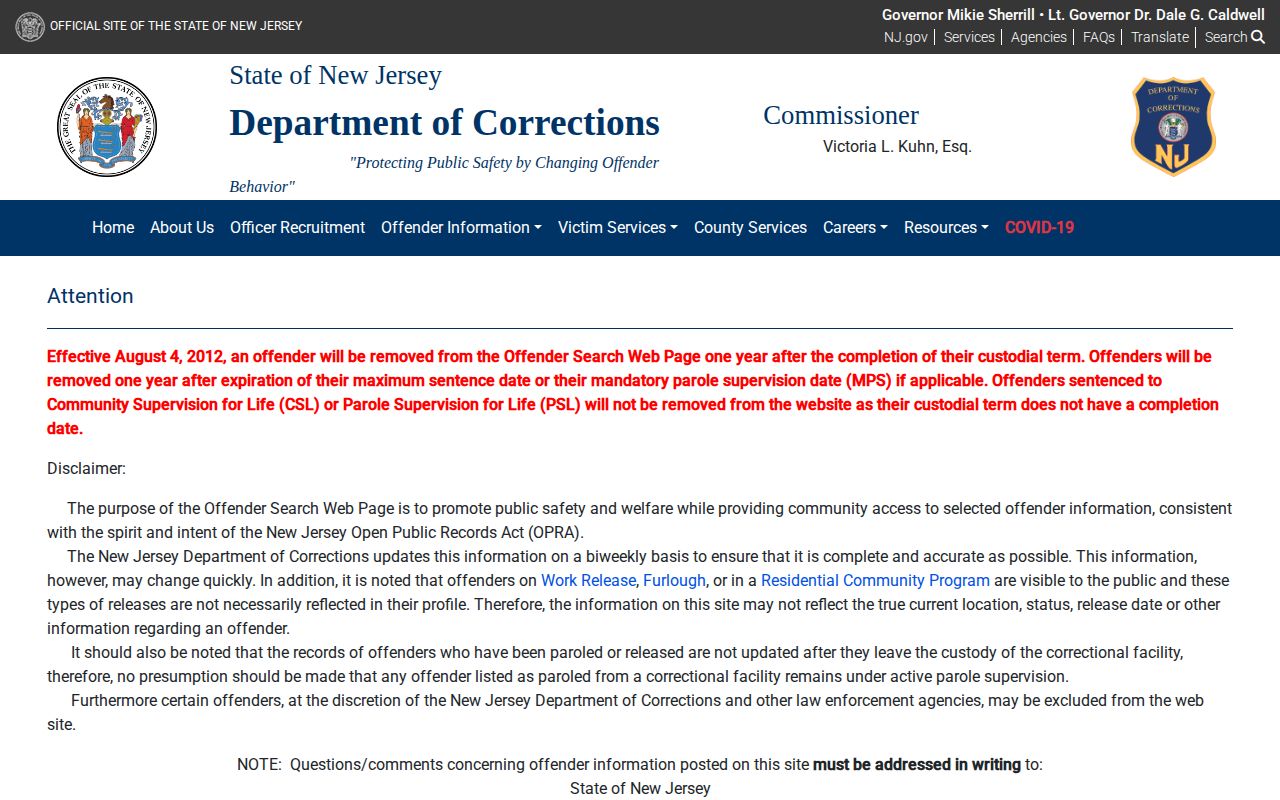
Open the complete matching history and compare identifiers because one person can have more than one admission, release, or return.
Request New Jersey Release Records
New Jersey's Open Public Records Act, N.J.S.A. 47:1A-1 et seq., provides the general route to identifiable government records. The Act was materially amended in 2024, so use the Government Records Council's current text and guidance. A narrow request works better than asking for a complete inmate file, which may contain confidential medical, victim, security, investigative, presentence, or risk material. Ask for electronic delivery, a fee estimate, redaction of exempt data, and release of any reasonably segregable part.
- Identify whether the episode belonged to a county jail or NJDOC. Use the New Jersey County Directory when the holding county is known.
- Give the full name, a booking or SBI number when known, the approximate custody dates, and the county or case identifier.
- Ask for the existing admission, movement, release, transfer, or final discharge record. Do not ask the custodian to create an explanation.
- Request the maintained release date, release or transfer code, authorizing order identifier, and receiving authority category if public.
- Keep the response, cited exemption, fee estimate, and any extension notice with the record.
The GRC says an ordinary complete noncommercial request is generally answered as soon as possible and no later than seven business days, unless an exception or valid extension applies. Its published ordinary paper rates are $0.05 per letter-size page and $0.07 per legal-size page, with possible actual delivery, media, or justified special-service charges. Those rates and timing should be checked at the time of a request.
Note: Court disposition can support the release story, but the holding agency remains the source for its exact physical release or transfer transaction.
Why NJDOC Records Disappear
The NJDOC public search is not a permanent archive. The agency's change notice says most records are removed one year after completion of the custodial term. Completion may depend on maximum-sentence expiration or mandatory-parole-supervision expiration, not simply the date the person left a prison. Community Supervision for Life and Parole Supervision for Life records remain because those custodial terms have no completion date.
This creates an unusual New Jersey result. Two people can leave physical custody on the same date, yet one record may stay online longer because the legal term continues. A missing result may instead reflect spelling, an alias, a county-only jail stay, an aged-off NJDOC record, or an expunged or restricted court matter. Use an SBI number when possible and request the maintained NJDOC record through its OPRA route after online removal.
Expungement can make public court information unavailable, but absence does not identify which legal or technical reason applies. Juvenile and protected records have additional limits. Never treat a no-result as proof that no custody episode occurred.
New Jersey Release-Day Documents
New Jersey publishes more release-day detail than many statewide systems. Under the Fair Release and Reentry Act framework, NJDOC conducts prerelease planning and helps with identification and benefit materials. The Office of Programming and Supportive Services says each person leaving NJDOC receives a release portfolio. Contents depend on the person's case and what was obtained before departure.
The portfolio can include a temporary NJDOC photo ID, a Social Security card or birth certificate when obtained, an MVC non-driver ID, final paperwork, current-charge information, a trust-account statement and remaining balance, a medical summary, detainer or warrant notice, purchased transit tickets, referrals, medication, and information on legal rights and public programs. The family guide adds possible debit-card, program transcript, parole instruction, and benefit material. The final paperwork and any parole reporting directions are the documents most relevant to the release and supervision timeline.
No official source reviewed promises universal cash gate money. The accurate financial detail is the person's remaining trust-account balance. NJDOC also says a releasing person may buy discounted NJ Transit bus or rail tickets before release. These are system procedures, not a promise that every portfolio contains every item.
New Jersey Fair Release Planning
The NJDOC Fair Release and Reentry Act page describes a statewide prerelease framework for identification, benefits, and transition preparation. The governing legislation is P.L.2009, c.329. These official routes explain the planning structure and the documents that may be sought before departure.
Program structure does not prove that a named person received a specific item or service. Verify the individual release through final paperwork, Date Out-of-Custody, and any supervision directions. The same Act also supports statewide release-outcome reporting, but those cohort reports answer policy questions rather than a current custody check.
New Jersey Release Scale
The 2024 Vocational Training Planning Board report places the NJDOC system at about 13,000 incarcerated people during the preceding three years and approximately 5,700 releases in calendar year 2024. The figure covers NJDOC releases. It is not a count of every county jail release, and it should not be added to unmatched county figures.
The State Parole Board's FY2024 report counted 15,892 people supervised, including 12,792 in general parole supervision and 2,525 in Community Supervision for Life. Some program categories overlap, so they cannot be summed as separate people. These statewide figures show system scale, not the custody status of any named person.
NJDOC maintains a release outcome report series for defined cohorts.
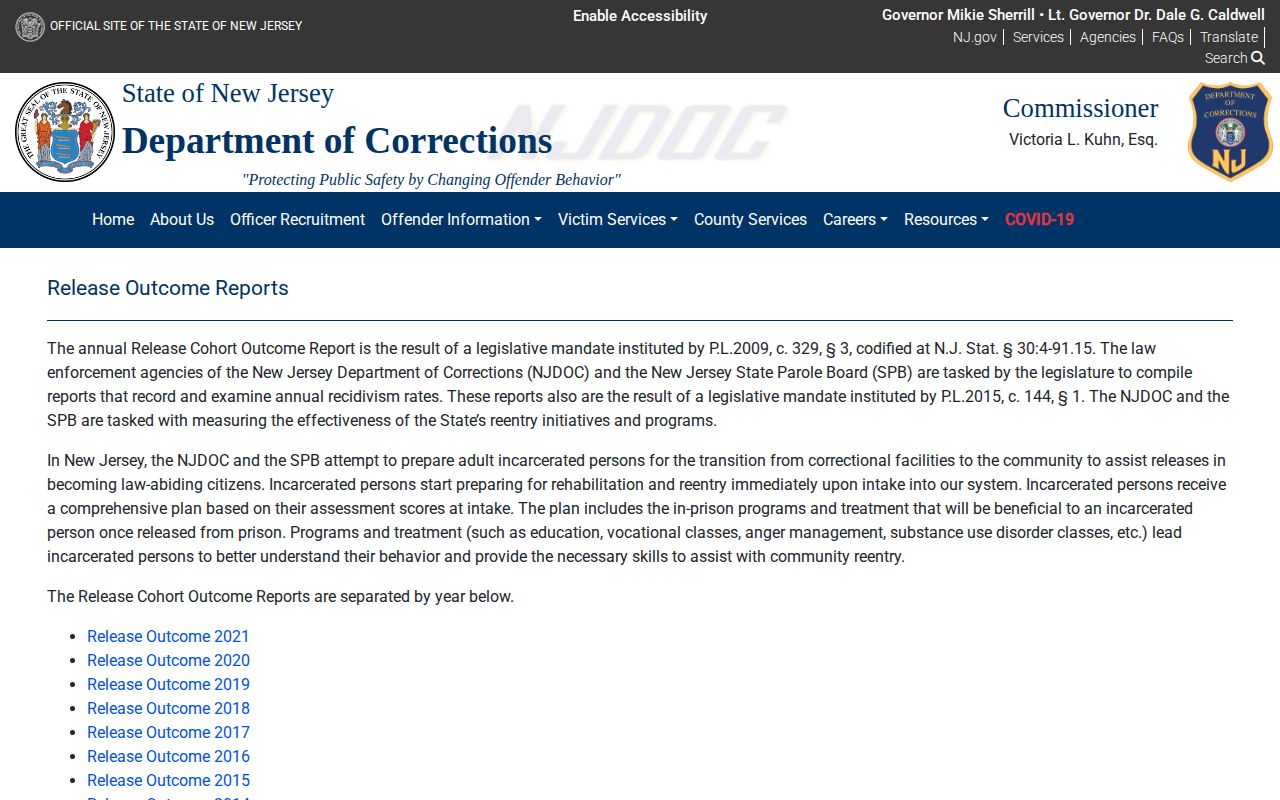
Those retrospective reports measure later outcomes and should not be used to verify a same-day release.
Find New Jersey Released Inmates
Start with the custody layer, then confirm the event. For a sentenced state prisoner, search NJDOC by SBI number or name and inspect every custody segment for Date Out-of-Custody. For a county jail stay, identify the actual holding county, not just the arresting town or sentencing county, and request that custodian's release transaction. Shared-service arrangements mean a person can be committed by one county and held by another.
- Match the person with a stable identifier, case number, date range, and alias information.
- Check NJDOC for a state sentence or the holding county for a local jail episode.
- Read the exact event label. Keep eligibility, projected dates, release, transfer, supervision, and discharge separate.
- Use the latest Superior Court or municipal docket to understand the judgment or later order.
- Check SPB, BOP, ICE, or another county when the release record points to supervision or transfer.
- Request the underlying agency record when the online result is absent, stale, or unclear.
Roster limit: A live jail roster shows present custody. Once a person leaves that roster, the release transaction or receiving agency record becomes the better source.
Note: NJDOC says its public data update biweekly and may not show a person's true current location, status, or release date.
NJDOC Search Date Labels
Three NJDOC labels answer three different questions. Current Max Release Date is the most recently calculated date after days earned off and days added for negative institutional conduct. NJDOC warns that it may change at the end of each month. Current Parole Eligibility Date is the most recent expected release date under State Parole Board calculation policy. It marks eligibility, not a grant or completed release. Date Out-of-Custody is the historical date released from custody for that incarceration segment.
- Projected date
- A forward-looking calculation that can change.
- Eligibility date
- A point when parole consideration may occur, not a release order.
- Date Out-of-Custody
- NJDOC's completed-event field for release from a custody segment.
- Discharge
- The legal endpoint of the applicable custody or supervision term.
The deeper NJDOC offender search page explains these state fields and retention rules in full.
New Jersey Supervision Records
Physical release and legal discharge are separate. SPB supervises parole, administrative parole release, NERA mandatory supervision, and lifetime-supervision categories. A Date Out-of-Custody can coexist with active parole, Community Supervision for Life, or Parole Supervision for Life. Verify present parole through the Board's contact and district-office routes, and seek the final certificate when the endpoint matters.
Probation belongs to the New Jersey Judiciary, not SPB. There is no verified open statewide person-name probation search. The Probation Client Portal serves authorized clients, not the public as a general lookup. Public verification begins with the sentencing case in Promis/Gavel or the municipal system, then the relevant county Probation Division for information that may lawfully be released. A judgment imposing probation does not prove it remains active because later orders can end, transfer, extend, violate, or revoke the term.
The SPB eligibility notice index shows weekly publication dates, consideration timing, comment deadlines, and possible release-through months.
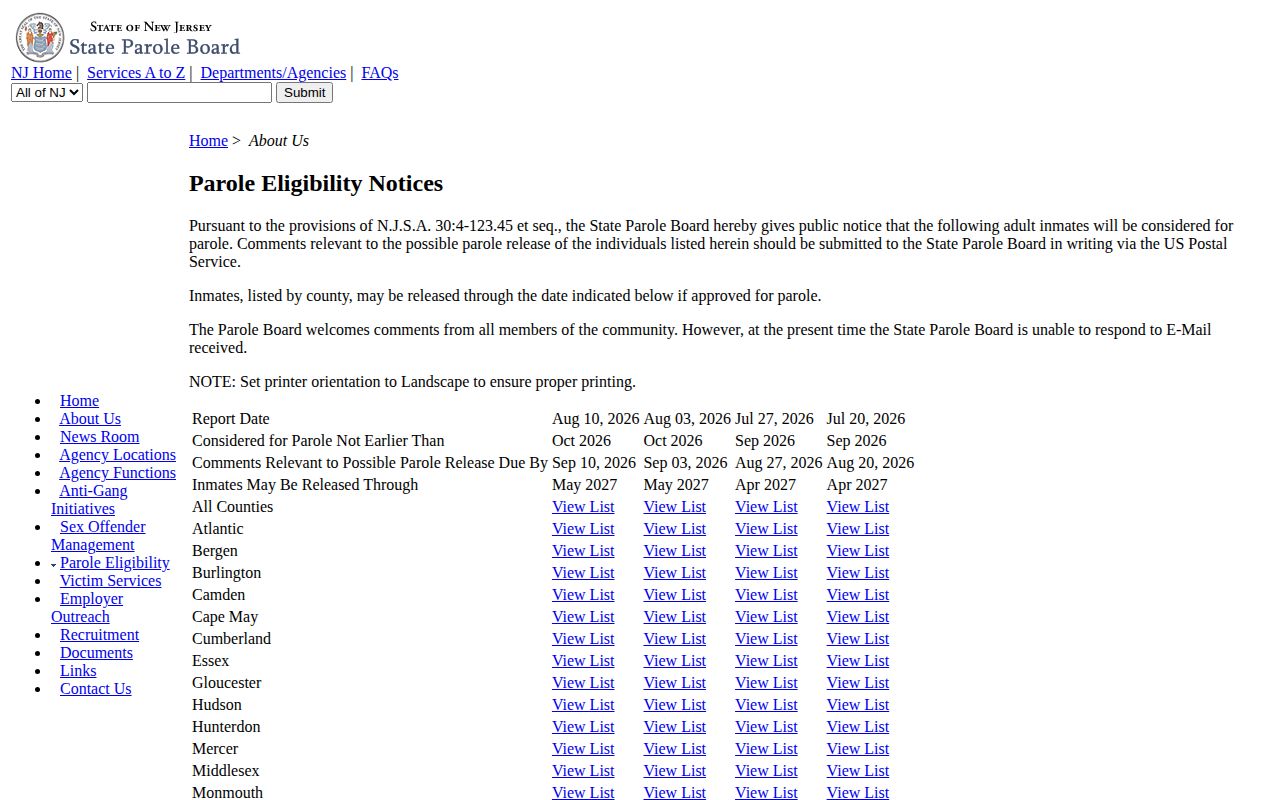
It is a notice calendar, not a name-searchable decisions database or proof that release occurred.
New Jersey VINE Release Alerts
New Jersey Enhanced VINE is best used prospectively. Find a specific person while the reporting agency still lists that person in custody, match the agency and identifiers, and register for the desired custody-change notice. The official brochure says telephone users create a four-digit PIN and enter it when a call arrives to confirm receipt. Registration is confidential and may need to be repeated for different services or events.
A release alert documents what the reporting agency sent. It may not state whether another county, NJDOC, BOP, ICE, a hospital, or the community received the person. A no-result is also inconclusive, and the current brochure does not establish complete present participation for every county. VINE is not a durable historical discharge archive.
The VINELink interface provides New Jersey search and registration controls.
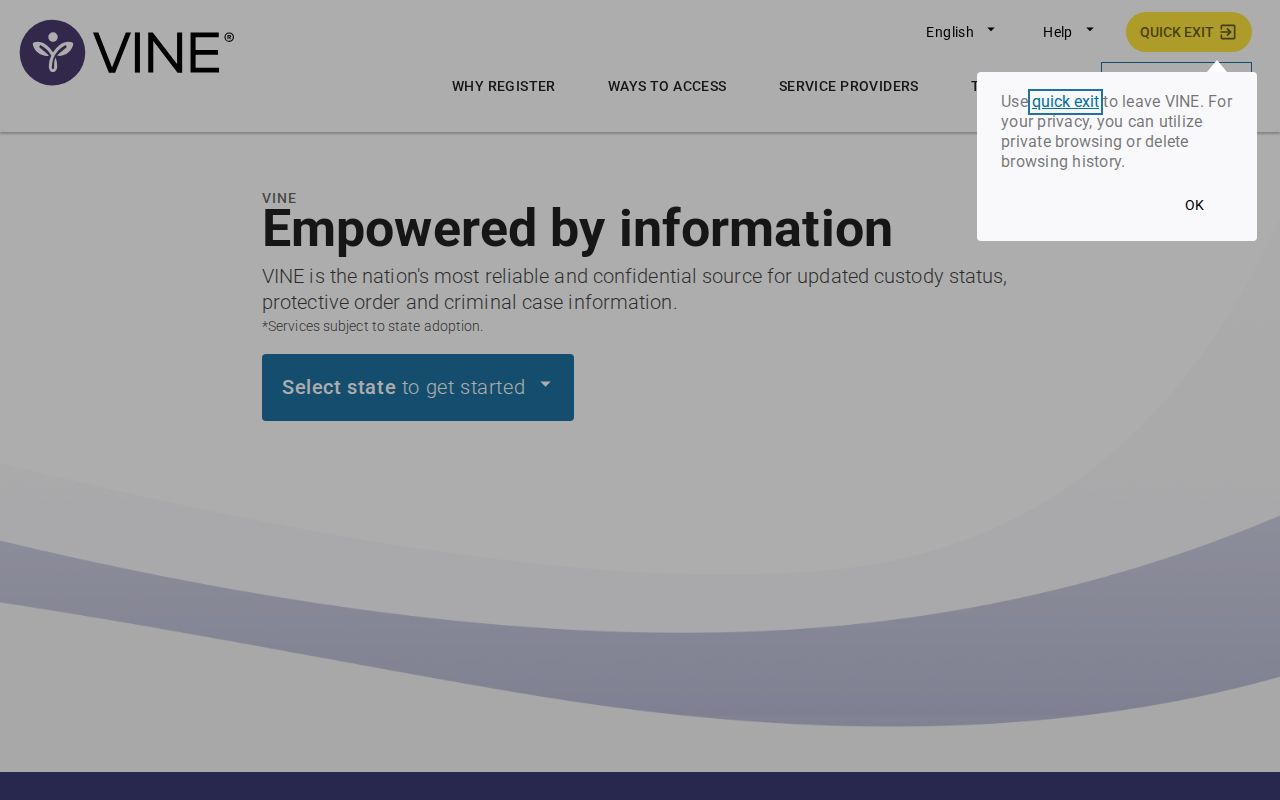
Preserve the confirmation details, then verify the reported event with the holding or receiving agency.
Federal and Immigration Releases
The BOP Inmate Locator covers federal Bureau of Prisons custody, generally from 1982 forward. Search by BOP register, DCDC, FBI, or INS number when known, or use a name. A past date paired with Released or Not in BOP Custody means BOP custody ended. It does not rule out state, local, immigration, or supervision authority. A future federal date remains projected.
The BOP locator displays the federal search framework.
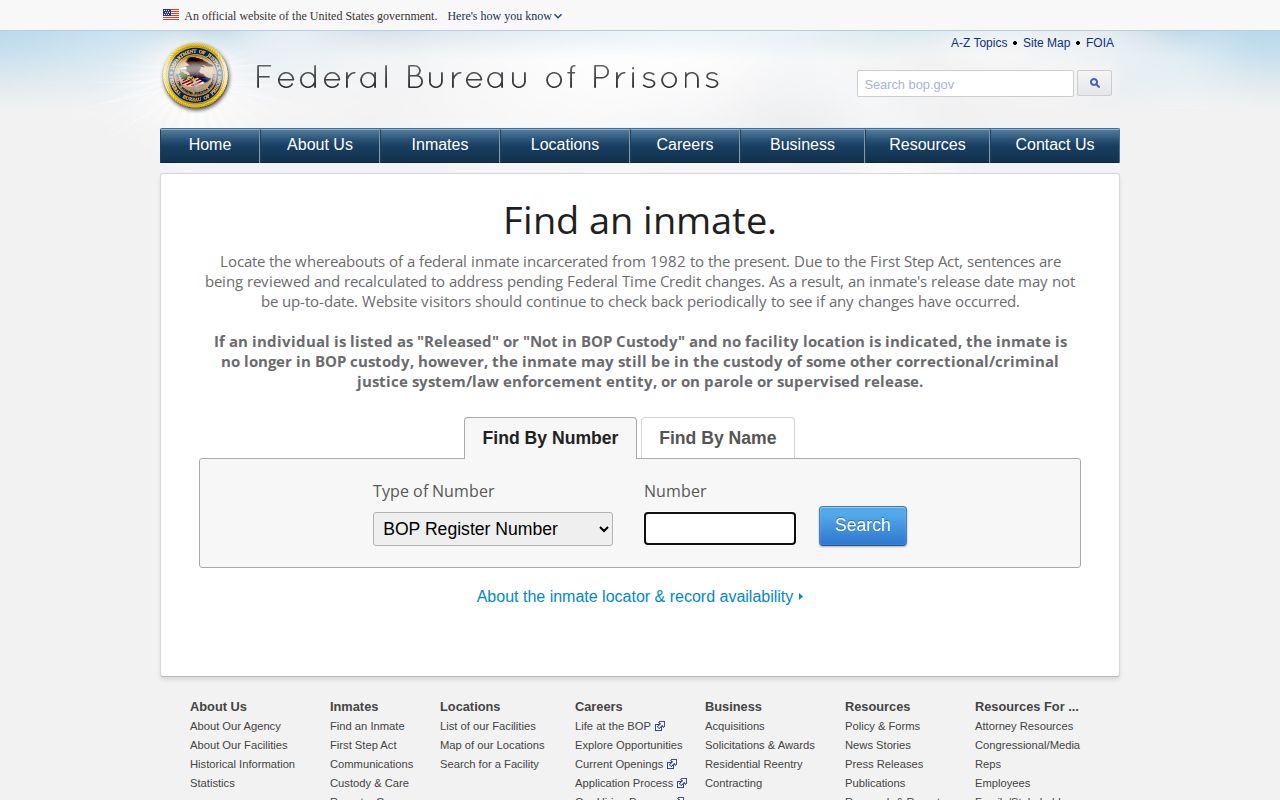
Older federal records may require the National Archives, while an agency record beyond the locator can be requested through BOP FOIA.
ICE's Online Detainee Locator has an A-number route and a biographical route for present or recent immigration custody. No ICE result does not prove release into the community or removal from the United States. County release, ICE assumption of custody, ICE release, and the immigration case outcome are separate events. Federal pretrial custody can also remain with the U.S. Marshals Service, which does not provide a public prisoner locator.
New Jersey Mugshot Record Law
A booking photo may be a government record, but New Jersey does not make every image automatically or permanently public. Request the specific photograph from the agency that created or maintains it, using the booking or SBI number and date. A county booking image, NJDOC identification image, police release, and news image belong to different custodians. The image itself does not prove conviction, current custody, or release.
P.L.2017, c.123, codified at N.J.S.A. 2A:58D-3 to -4, targets demands for payment not to disclose identifying criminal-justice information, including arrest photographs. It creates remedies and penalties. It is not a general ban on lawful publication or a universal takedown right. Ordinary access remains subject to OPRA, exemptions, privacy rules, and expungement.
New Jersey's public-record framework is purpose-neutral. A narrow agency request, a current court record, and the exact custody label provide more reliable evidence than an undated image copied away from its original source.
Find Releases by New Jersey County
New Jersey's 21-county custody map includes shared services and cross-county placement arrangements. County of arrest, county of commitment, physical jail, and records custodian can differ. Follow the facility that actually held the person for its release transaction, then move to NJDOC, BOP, ICE, or another county if the record shows a transfer. The county directory lists each locality site and county seat, while the facility directory distinguishes active jails, prisons, residential correctional programs, federal facilities, juvenile settings, closed sites, and processing hubs.
A county transfer to NJDOC is a local release and a state admission, not community release. Likewise, an RCRP move remains correctional custody until NJDOC records the later out-of-custody event. Use the statewide facility directory to find the exact institution and its covered county page.
| Question | Correct route |
|---|---|
| Still in a county jail? | Current holding county roster or jail contact |
| Released from a county jail? | Holding county release transaction and court record |
| Released from NJDOC? | NJDOC incarceration history and Date Out-of-Custody |
| Under supervision? | SPB for parole or Judiciary county office for probation |
| Federal or immigration transfer? | BOP or ICE locator and agency records request |