
New Jersey Enhanced VINE Scope
New Jersey calls its program New Jersey Enhanced VINE. VINE means Victim Information and Notification Everyday. It offers a specific-person custody check through VINELink and a toll-free telephone route at 1-877-846-3465. The official brochure also lists TTY service at 1-866-847-1298. The brochure describes information about people who are in custody. That wording matters. The sound use is to find the person while a participating agency still reports the custody record and register for a later release, transfer, or other offered custody-change event.
VINELink is not one combined New Jersey jail database. Each reporting agency supplies its own record and timing. The current official brochure does not list present participation county by county, so statewide access must not be read as proof that every county jail supplies every event. When a county record does appear, the agency name helps identify the custody being watched. A state prison record, county jail record, and local transfer event are separate custody episodes even when they involve the same person.
The VINELink New Jersey workflow is visible in the successful state screenshot.
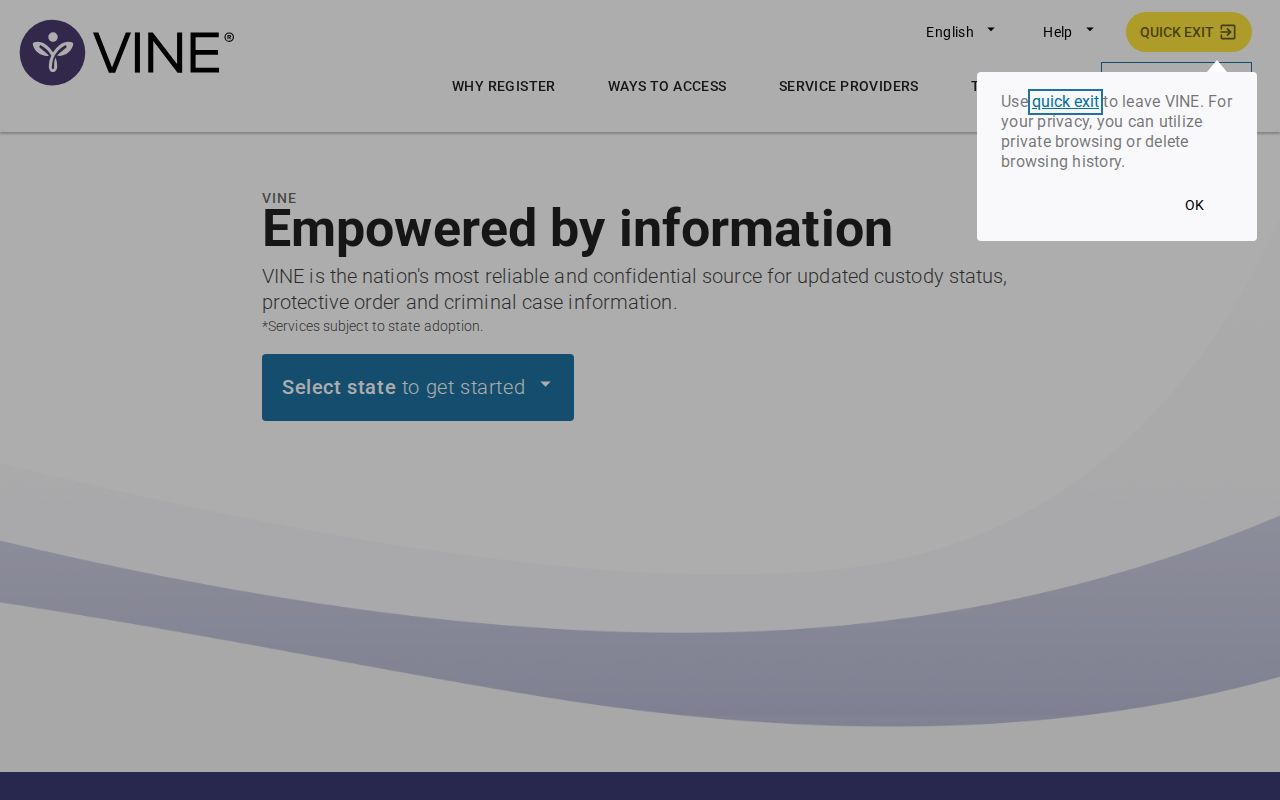
The screen is the starting point for a name or identifier search and for notification options tied to the matched record.
Search One New Jersey Person
Begin with enough facts to separate people who share a name. A known spelling, the reporting agency, an available date of birth, an SBI number, or another identifier shown by the current interface can help. SBI means State Bureau of Identification number, New Jersey's state corrections identifier. Never choose a record from the name alone when two results could fit. The reporting agency and displayed identifiers should agree with the custody episode being checked.
- Open VINELink and select New Jersey as the state.
- Enter the person's name and any available identifier accepted by the current form.
- Review each possible match for the reporting agency and identifying details.
- Open the matching record and read the exact custody wording and its timestamp.
- Save the agency name, identifier, status language, and time checked before registering.
A no-result does not settle release status. The person may have been released and removed from the custody search, entered another agency's custody, been recorded with a different spelling, or fallen outside the reporting data. For a county episode, use the New Jersey County Directory to identify the actual holding county and its release-record route. County of arrest is not always the county that held the person.
Note: Match the custody agency before treating a status as the event sought, especially when counties use shared or cross-county placement arrangements.
Read New Jersey VINE Fields
Record fields vary with the agency and the current interface. Quote what appears instead of translating it into a broader claim. A custody label identifies the reporting system's status. A facility or agency identifies where that status came from. An event time shows when the reported change was recorded, not necessarily when every receiving system updated. If a date is described as scheduled or expected, it remains prospective. It is not an actual release record.
| Field | How to read it |
|---|---|
| Name and identifier | Use both to distinguish the intended person from a similar name. |
| Reporting agency | Identifies the jail, corrections agency, or other source of the custody event. |
| Custody wording | Describes only the status reported by that agency at the displayed time. |
| Facility or location | Shows the reported holding location, when the agency supplies one. |
| Event and timestamp | Records the reported custody change and when the system posted it. |
| Notification options | Lists the channels and events currently offered for that record. |
A released alert closes the reporting custody. It does not by itself say where the person went. Community release is only one possibility. Another county, NJDOC, federal custody, immigration custody, a hospital, or another institution may become the next custodian. Keep the alert's exact words and compare them with the next agency's record when destination matters.
Register New Jersey Release Alerts
Registration begins from the matched custody record. Choose only the event and delivery methods the live service offers. Those may include phone, text, email, app, or TTY channels. The official brochure says registration is confidential. Separate registrations may be needed for different services or events, so one confirmation should not be assumed to cover every notice type.
- Open the correct person's record and select the notification option.
- Choose the release or custody-change event offered for that record.
- Register each desired phone, text, email, app, or TTY channel separately when required.
- For telephone alerts, create the four-digit PIN requested by New Jersey Enhanced VINE.
- Keep the registration confirmation and PIN in a secure place.
- When a call arrives, enter the PIN to confirm receipt, then recheck the custody record.
The PIN confirms that the notification call reached the registrant. It is not an inmate number and does not prove the event is final. Preserve the alert time and reporting agency. If an expected alert does not arrive, revisit the record and use the toll-free or TTY route rather than assuming custody stayed the same.
Confirm a New Jersey Alert
First identify the event that triggered the notice. Release, transfer, escape, return to custody, and another custody change do not mean the same thing. Then note which agency reported it. A county release transaction can be followed by NJDOC admission. A local release can also be followed by federal or immigration custody. The alert gives a strong lead about one custody episode, but the next agency's record answers the next question.
Important: A VINE release alert ends the reporting agency's custody. It does not prove unconditional release into the community or the end of parole, probation, or another legal term.
The NJDOC offender search provides a separate statewide state-prison check.
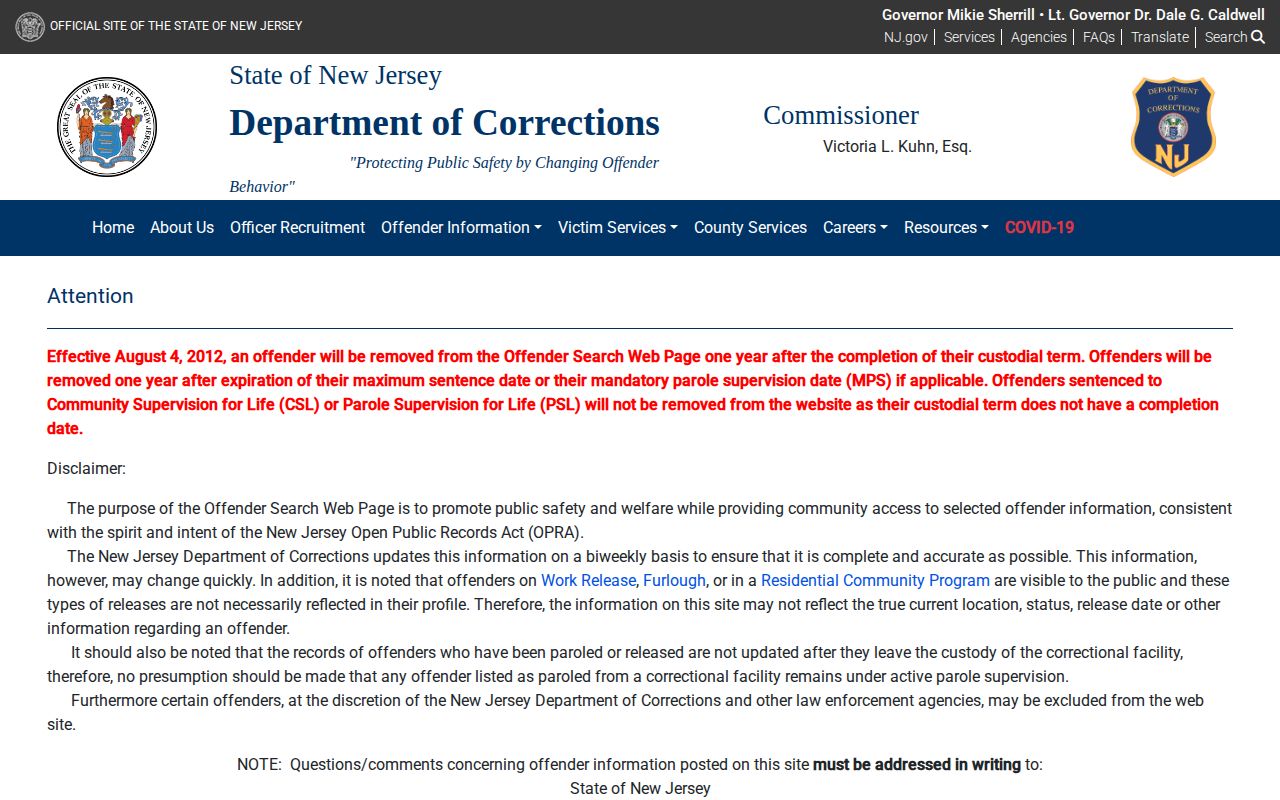
NJDOC's results use agency-specific fields, so an NJDOC custody segment must not be inferred from a county VINE event alone.
For an NJDOC record, Date Out-of-Custody is the historical field that records release from NJDOC custody. Current Max Release Date and Current Parole Eligibility Date are calculations, not completed events. The NJDOC Offender Search page explains those state fields and their retention limits. A county release should instead be confirmed with the holding county's release transaction or records custodian.
Reporting Agency Controls the Alert
New Jersey Enhanced VINE is statewide in access, but the reporting agency controls the facts and timing shown for its custody. The official current brochure does not provide a live county-by-county participation table. Older rollout claims cannot establish complete present coverage. It would also be wrong to promise that each county supplies identical status labels, event types, or update speed. The record should be read as an agency report, not as a full New Jersey custody history.
A result can lag an event at the jail. A receiving system may update later. Name and identifier mismatches can also block a search. When no result appears, check the spelling, any known identifier, and the expected reporting agency. Then contact that agency or request the release transaction. The same caution applies after a notification. An alert may document that the first agency ended custody while giving no name for the next custodian.
This reporting-agency limit is New Jersey's key VINE deployment quirk. It preserves the difference between a useful notification and a certified release history. It also explains why county of arrest, county of commitment, physical jail, and records custodian can point to different offices in a shared-services state.
Federal Custody Uses BOP
VINELink does not replace the federal Bureau of Prisons locator. A person in federal BOP custody should be searched by register number or another accepted federal identifier when known, or by name. A BOP result can show identifying data, a federal status or location, and a release date. A past date with Released or Not in BOP Custody ends only BOP custody. A future date remains projected.
The BOP Inmate Locator is shown in the successful federal screenshot.
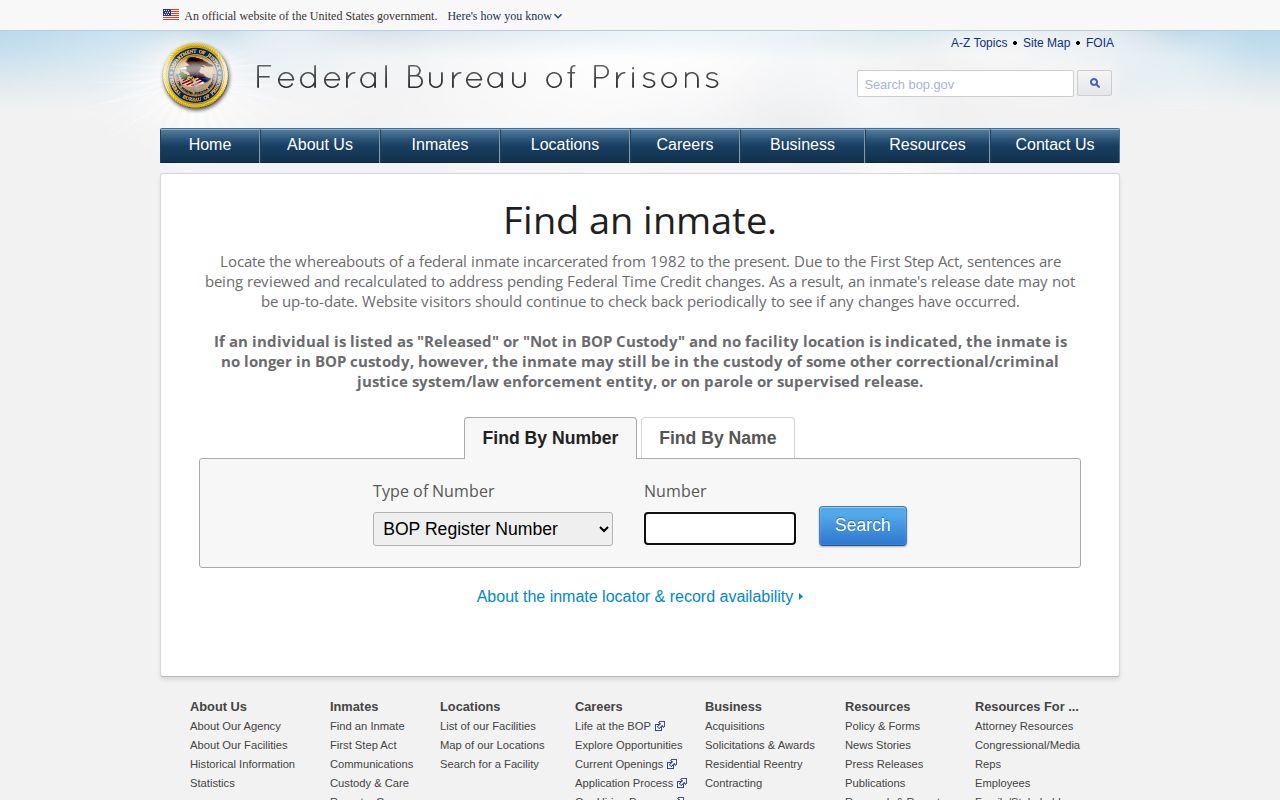
The federal search is a separate route and cannot fill a missing county or NJDOC VINE event.
Federal pretrial custody may remain with the U.S. Marshals Service, which has no public prisoner locator. Immigration custody also uses a different locator. A local VINE no-result cannot prove that neither federal nor immigration custody exists. Keep local release, federal assumption of custody, immigration assumption of custody, and later discharge as distinct events.
VINE and Parole Notices Differ
VINE notification registration is not State Parole Board registration. A custody-change alert does not enroll anyone for parole-hearing communications. The New Jersey State Parole Board uses its own victim-services and records routes. Its public weekly eligibility notices show consideration timing, a comment deadline, and a possible release-through month. They are not a name-searchable decision result and do not prove that release was granted.
The State Parole Board weekly publication shows the separate eligibility-notice system.
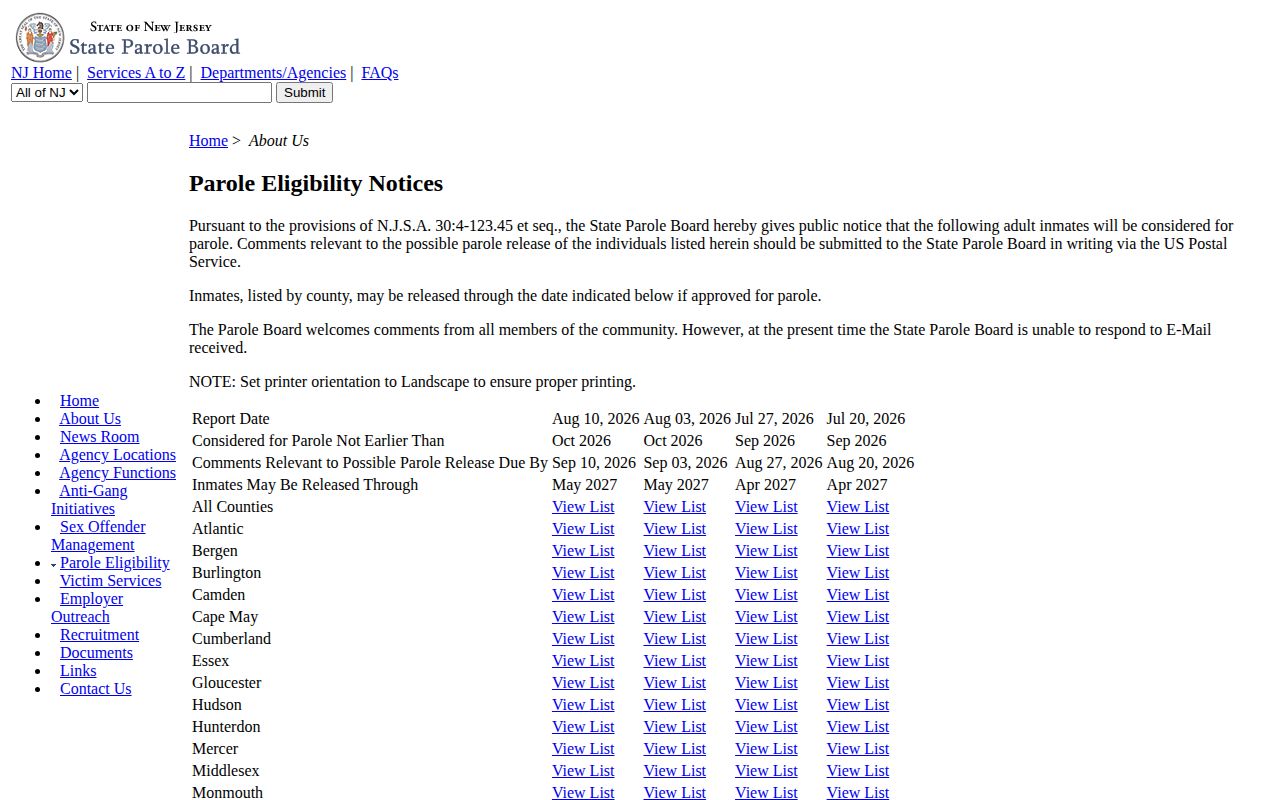
The publication supports hearing timing, while VINELink reports custody events supplied by its reporting agencies.
Use each official registration process for the notice needed. For present custody, read the VINE record. For a parole outcome, seek the Board's final public decision or record. For urgent safety concerns, use emergency and official victim-services channels. VINE itself warns against relying on the service alone for safety.
Resolve a New Jersey No-Result
A no-result is inconclusive. Start with the known custody chain rather than broad guesses. Identify the arresting agency, the physical holding facility, and any expected transfer. Search again with the best identifier. If the person was in a county jail, ask that jail's records custodian for the booking, release, or transfer transaction. If a transfer to state prison was expected, check NJDOC. Use BOP or immigration routes only when the facts point to those systems.
- Release
- The reporting agency ended its custody, which may or may not mean community release.
- Transfer
- Custody moved to another facility or authority.
- Discharge
- The relevant custodial or supervision term ended, as shown by the responsible agency's final record.
- Data lag
- The real-world event occurred before the reporting system posted or synchronized it.
Keep the final evidence in sequence: the VINE registration, alert wording, agency timestamp, county release record, NJDOC Date Out-of-Custody, or federal status, as applicable. No single missing search result should be turned into a claim that all custody ended.