
New Jersey Parole Hearing Stages
The New Jersey State Parole Board is the agency that conducts state parole hearings and issues parole decisions. Its public process distinguishes an initial hearing from Board-panel consideration, a rescission hearing, and revocation proceedings. Those terms are not interchangeable. An initial review may send a matter to a panel. A panel can grant parole, deny it and set a future eligibility term, or defer action while seeking more information.
A grant is an agency decision, not automatic proof that the person walked out that day. The release may depend on a future date, an approved plan, conditions, or the absence of adverse information that could prompt rescission review. After release, an alleged violation can lead to probable-cause and final revocation proceedings. That later process asks whether supervision should continue or be revoked. The custody history must be checked again if a return occurs.
| Hearing stage | Main question | Record to seek |
|---|---|---|
| Initial hearing | Should the matter go to a Board panel? | Initial-hearing record and referral |
| Panel consideration | Should parole be granted, denied, or held for more facts? | Final panel decision and date |
| Rescission hearing | Should a grant change before release because of adverse information? | Rescission decision |
| Revocation proceeding | Should parole continue after an alleged violation? | Probable-cause and final revocation records |
The State Parole Board hearing page presents these official process categories.
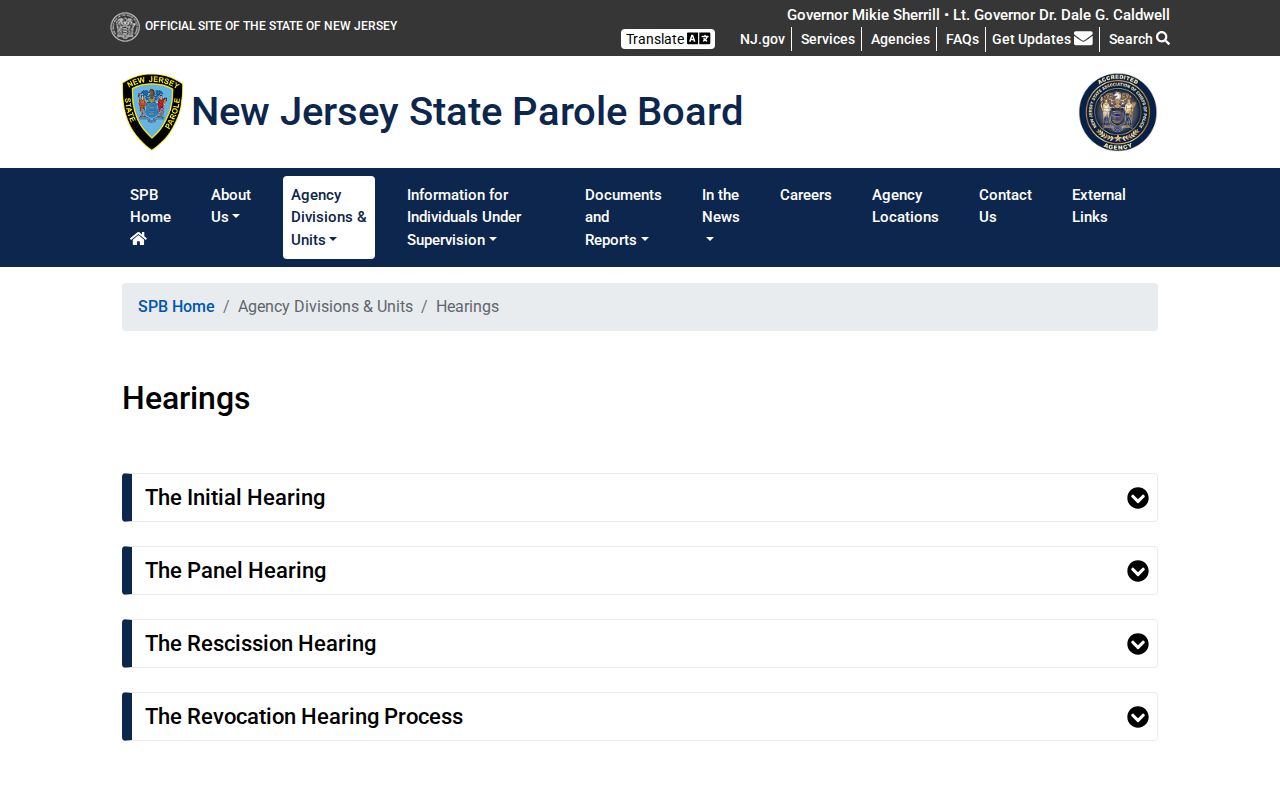
The separate stages show why a scheduled review, a grant, physical release, and final discharge need their own dates.
Find New Jersey Parole Eligibility Notices
The State Parole Board's public calendar substitute is its Parole Eligibility Notices index. It is arranged in weekly-dated report columns. The linked tables identify a county or location grouping, the month in which consideration may occur, a deadline for public comment, and a month through which release may occur if parole is granted. An all-counties view supports a statewide sweep, while county links narrow the list.
Use the report as a lead, not a result. A notice states that consideration may occur. It does not say the hearing was completed, the panel granted release, or the person left custody. The possible release-through month is also conditional. Because current links and report dates can change or lag, save the displayed report date and the date it was checked.
- Open the official Parole Eligibility Notices index and choose the relevant weekly report.
- Use the all-counties notice for a broad check or select the county or location grouping tied to the record.
- Match the name with the SBI number or other available identifiers before treating the row as the same person.
- Record the consideration month, public-comment deadline, possible release-through month, report date, and access date.
- Continue to the Board's record route for the individual outcome after the hearing stage.
The weekly eligibility-notice index is the official public starting point.
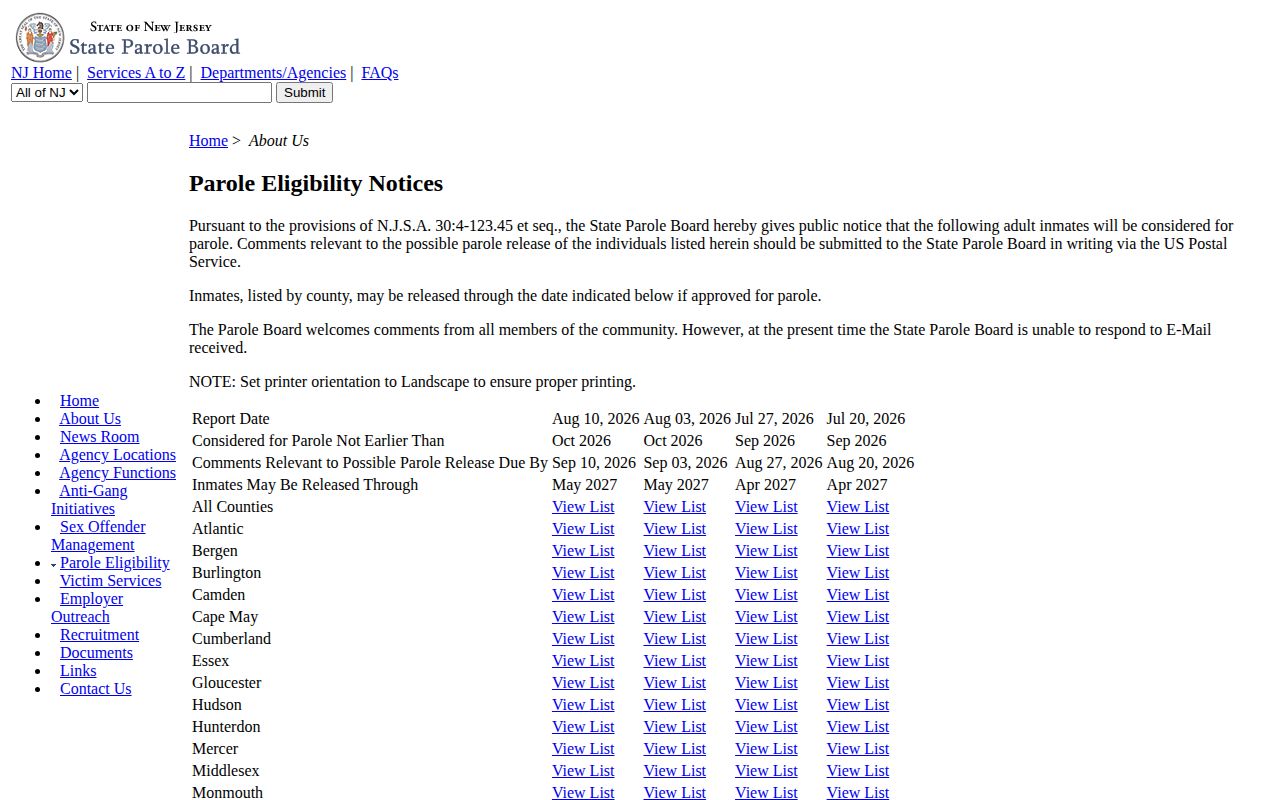
The date columns and possible release window should remain labeled as notice information, never as a parole decision or completed release.
Note: Save both the report's own date and the day it was accessed because a current endpoint may later point elsewhere.
Request New Jersey Parole Decisions
As of the research date, no official State Parole Board public name-searchable database of individual parole decisions or results was verified. The weekly notice is not that database. The annual report supplies aggregate counts, not case outcomes. The accurate fallback is the Board's documents, reports, OPRA, and public-information route. A focused request can identify the person and ask for an existing final decision or order to the extent it is publicly disclosable.
Separate the possible records before asking. A panel decision shows whether parole was granted, denied, or otherwise handled. A denial may include a future eligibility term. A grant may identify a future or conditional release. Rescission has its own decision. Revocation after release has probable-cause and final stages. Present supervision and final discharge also involve different records. One broad request for an entire file is less precise and more likely to include exempt material.
- Provide the full name, SBI number when known, facility or county connection, and approximate hearing period.
- Name the exact existing record sought, such as a final panel decision, rescission decision, or final revocation order.
- Ask for the decision date, outcome, future eligibility term or granted release date if maintained and disclosable.
- Request electronic delivery and ask the custodian to redact exempt content while releasing any reasonably separable public part.
- Use the NJDOC custody history to check whether a later physical release event appears.
The SPB documents and records page carries the official request materials.
This request route avoids turning a public eligibility notice into a decision that the notice never made.
New Jersey Parole Hearing Outcomes
Outcome words need context and a date. A grant authorizes parole under the terms of the decision, but may not produce same-day release. A denial does not prove permanent ineligibility; it may establish a future eligibility term. A deferral or request for more information leaves the matter unresolved. Rescission can alter a prior grant before physical release. Revocation concerns a person already released to parole supervision.
| Outcome | Meaning | Next check |
|---|---|---|
| Granted | The panel approved parole subject to its date and conditions | Check release plan, later review, and Date Out-of-Custody |
| Denied | The panel did not approve parole at that review | Read the future eligibility term and later notice |
| Deferred or held | The panel needs more information or later action | Obtain the later final decision |
| Rescinded | A prior grant changed before release | Use the rescission order and current custody record |
| Continued after violation | Supervision continues after revocation review | Read the final revocation decision and conditions |
| Revoked | Parole was ended through the revocation process | Check the new custody admission and later eligibility |
New Jersey's fiscal-year report illustrates the range without serving as a personal lookup. It recorded state initial hearings scheduled, hearings conducted, referrals, panel grants, denials, and other dispositions. It also reported final revocation decisions split between continuation and revocation. These are case-processing counts. They should not be treated as a count of unique people physically released.
Critical distinction: “Eligible,” “scheduled,” “granted,” “released,” “supervised,” and “discharged” each describe a different point in the record.
New Jersey Parole Eligibility Law
N.J.S.A. 30:4-123.51 supplies the ordinary parole-eligibility framework, including the role of mandatory minimums and applicable credits. It must be read with the actual judgment and any statute that controls the sentence. A general formula cannot replace the Board's current calculation. Consecutive or concurrent terms, county terms, life terms, mandatory terms, credits, and sentence-specific law can change the date.
For covered violent crimes, the No Early Release Act requires service of eighty-five percent of the sentence imposed before parole eligibility and adds a mandatory-supervision period after release. That rule does not apply to every New Jersey prison sentence. The judgment, covered offense, and agency calculation determine whether it governs a specific case.
The Earn Your Way Out Act created administrative parole release and compliance-credit changes within its statutory review structure. “Administrative” does not mean that release occurs without records or on the first date a search user sees. Check the current parole eligibility field, the Board's notice and decision, any detainer, and the actual Date Out-of-Custody. A detainer may change where the person goes even when one custodial authority releases them.
Note: The live agency calculation is safer than a homemade estimate because it incorporates the sentence record and later adjustments.
New Jersey Parole Decision Statistics
The State Parole Board's fiscal-year report gives useful scale with strict limits. It reported 4,133 state initial hearings scheduled, 3,513 conducted, and 2,938 referred to a panel. Two-member panels decided 3,564 matters, including 1,552 grants and 1,389 denials. Separate administrative parole release certifications and other dispositions explain why grants plus denials do not equal all decisions. Full Board matters included 39 grants and 13 denials, while county panel hearings produced 263 grants and 232 denials.
Those numbers describe decisions or proceedings during FY2024. They do not show that the same number of unique people left a prison, nor do they identify an outcome for a named person. The same report counted 1,477 final revocation decisions, with 347 continued on parole and 1,130 revoked. Again, an aggregate total cannot settle an individual case.
The FY2024 State Parole Board annual report provides the official tables and definitions. Record the reporting period whenever a figure is used. For a person, return to the final case decision and custody record instead of inferring from a statewide grant rate.
Statistics answer how much work the Board processed. They do not answer who was released. Keeping that line clear prevents statewide totals from becoming false individual claims.
New Jersey Notices Are Not Results
New Jersey's most important parole-policy quirk is the label on its public publication. Although the notice index may look like a calendar, it is a weekly eligibility and public-comment series. It shows consideration timing and a possible release-through month. It does not display a verified individual decision result. Relabeling that table as “parole results” would convert a possible future event into a false completed outcome.
Three records should be kept apart. The notice supports a statement that a person was listed for possible consideration in a given period. The final decision supports the outcome reached by the Board. NJDOC's historical Date Out-of-Custody supports the later fact that state correctional custody ended for that segment. If supervision follows, the SPB discharge certificate marks a still later endpoint.
The Board's contact and public-information route can help identify the proper office for an outcome inquiry. If a decision is not publicly available, say so. An unanswered or restricted request does not permit a guess. Victim-identifying, safety, deliberative, investigatory, and other exempt matter may be redacted or withheld under applicable law.
Confirm New Jersey Parole Release
After obtaining a grant, check the NJDOC record for the actual custody event. The public search uses Current Parole Eligibility Date for the expected date calculated under Board policy. It uses Current Max Release Date for a changing maximum-date calculation. Neither field proves the person left. Date Out-of-Custody is the historical release field for an incarceration segment.
The NJDOC offender search gives the statewide custody layer after the hearing record is known.
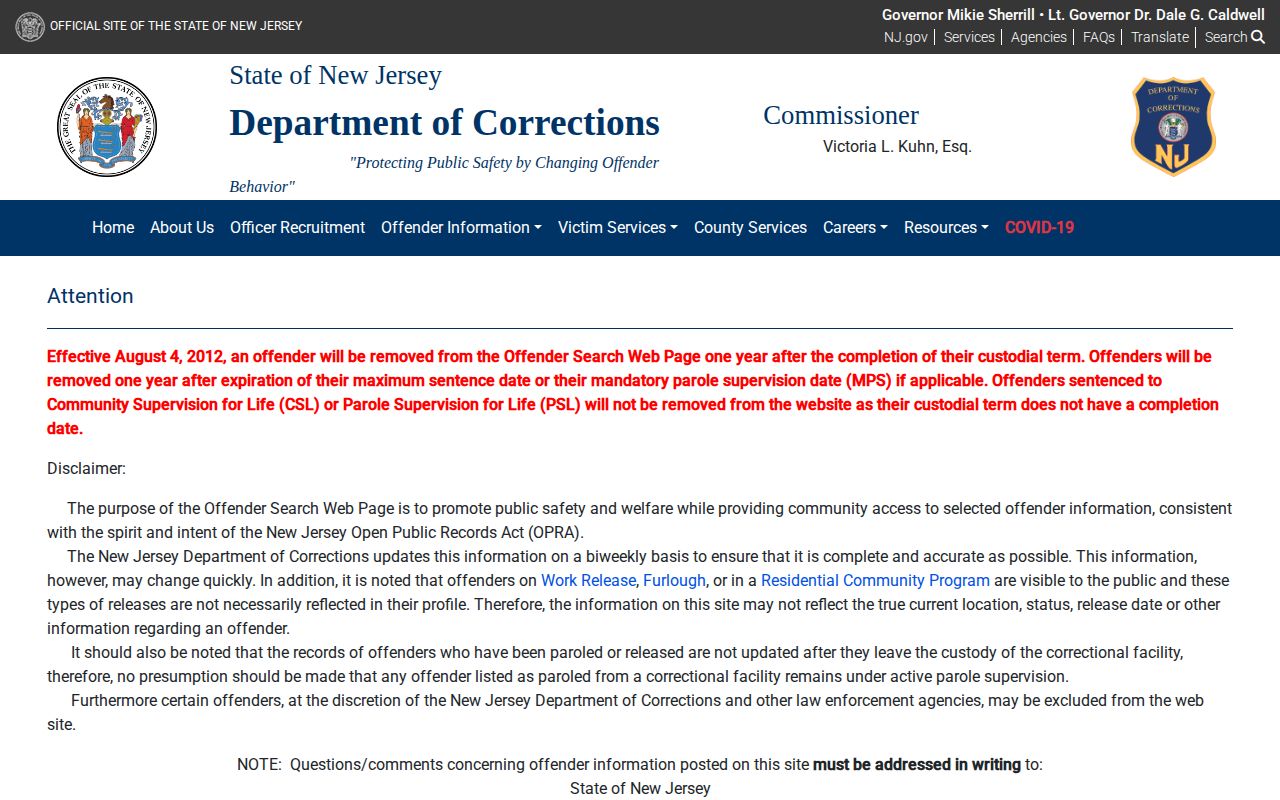
Copy the exact custody wording and event date, then note the date the record was checked because NJDOC warns that public data update on a schedule.
A person may leave NJDOC and still be supervised. The Parole / Probation coverage explains how to route the current-status and final-discharge check. If the NJDOC record has aged out under the agency's removal policy, request the existing movement, release, or discharge record rather than treating the no-result as proof.
The strongest conclusion joins the stages without collapsing them: eligibility notice, dated final decision, actual Date Out-of-Custody, present supervision record, and final discharge when it occurs. If one stage is missing, name the gap. That approach protects the difference between a planned release, a completed release, and the end of legal supervision.