
NJDOC Offender Search Steps
The official NJDOC offender search covers people within state corrections jurisdiction. It is not a statewide county jail roster. Start with an SBI number when it is known. NJDOC defines that number as the state identification number assigned to the person, so it is a strong way to avoid a same-name match. A name search can also work. Compare aliases, physical details, county of commitment, case number, sentence date, offense, and sentence history before relying on the result.
Open the matching profile and read the full incarceration history. Do not stop at the first status line. A person may have more than one admission, release, or return. An old Date Out-of-Custody does not prove the person stayed out after a later admission. The search disclaimer also says the data update biweekly, may not show the true current location or release date, and are not updated after the person leaves correctional-facility custody.
- Open the official search and accept its terms.
- Enter the SBI number, or use the name fields.
- Match the result with case and identity details.
- Open every relevant incarceration-history segment.
- Record the exact field wording and access date.
The NJDOC home page shows the agency and its statewide offender-information route.
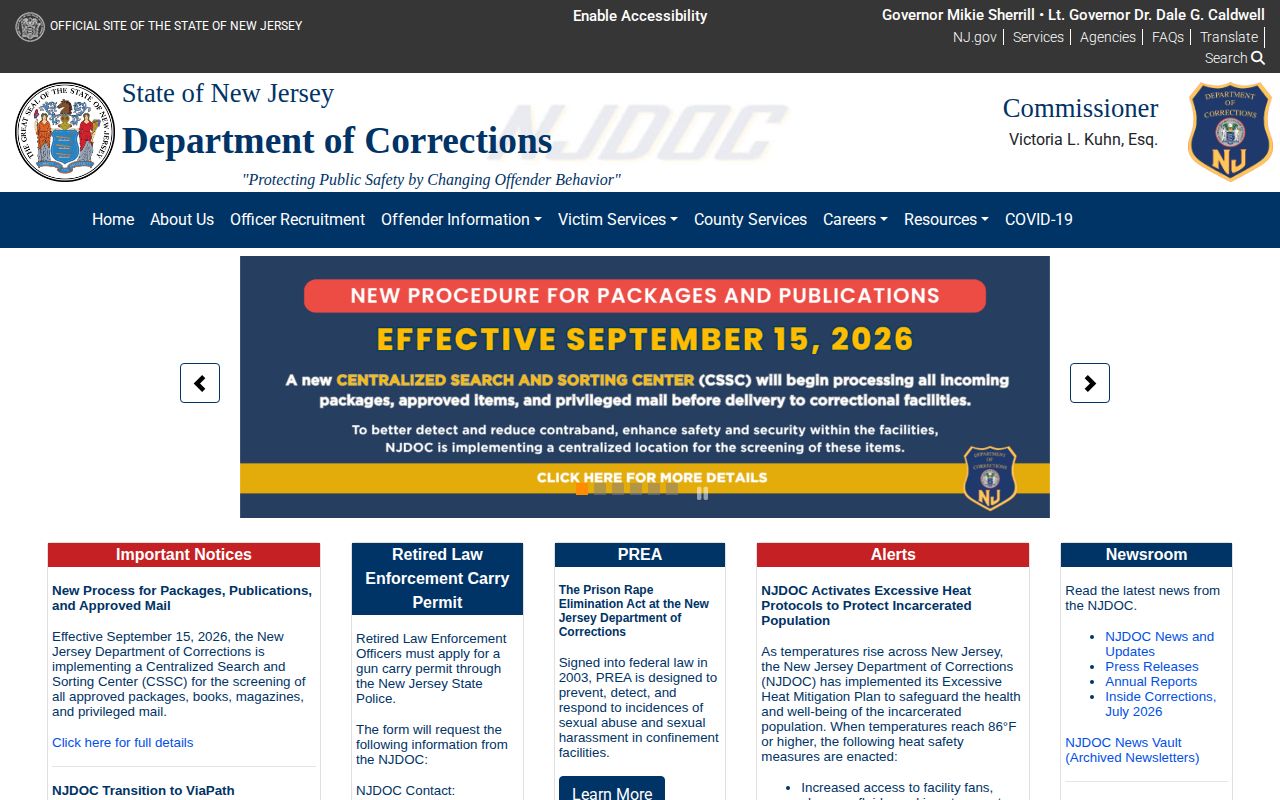
This official entry point helps distinguish the Department's state-prison records from records held by county custodians.
NJDOC Release Record Fields
A released-person check depends on exact fields. The NJDOC help material lists aliases, identifying details, county of commitment, case and sentence information, current facility, and incarceration history as possible record elements. The completed event appears in the history. Pair the Date Out-of-Custody with its Date In-Custody and the matching sentence segment. That pairing identifies which custody episode ended and guards against confusing an earlier departure with a later one.
| Field | How to Read It |
|---|---|
| SBI Number | The state identifier used to distinguish people with similar names. |
| Date In-Custody | The start of the specific NJDOC custody segment. |
| Date Out-of-Custody | The date released from custody for that historical segment. |
| Current Facility | The displayed location or status wording, which must be quoted as shown. |
| Sentence History | Terms, offenses, case details, and related dates tied to the record. |
| County of Commitment | The committing county, not necessarily the site of every custody event. |
The public system has no single universal release-status phrase. Historical results can use wording such as “Released from” or “Released by Court” with a facility abbreviation. Copy the actual phrase. A halfway house entry is also not the same as an unconditional discharge. NJDOC defines that setting as a community-based residential placement for people who meet departmental rules.
The offender-search screen presents the official NJDOC search workflow.
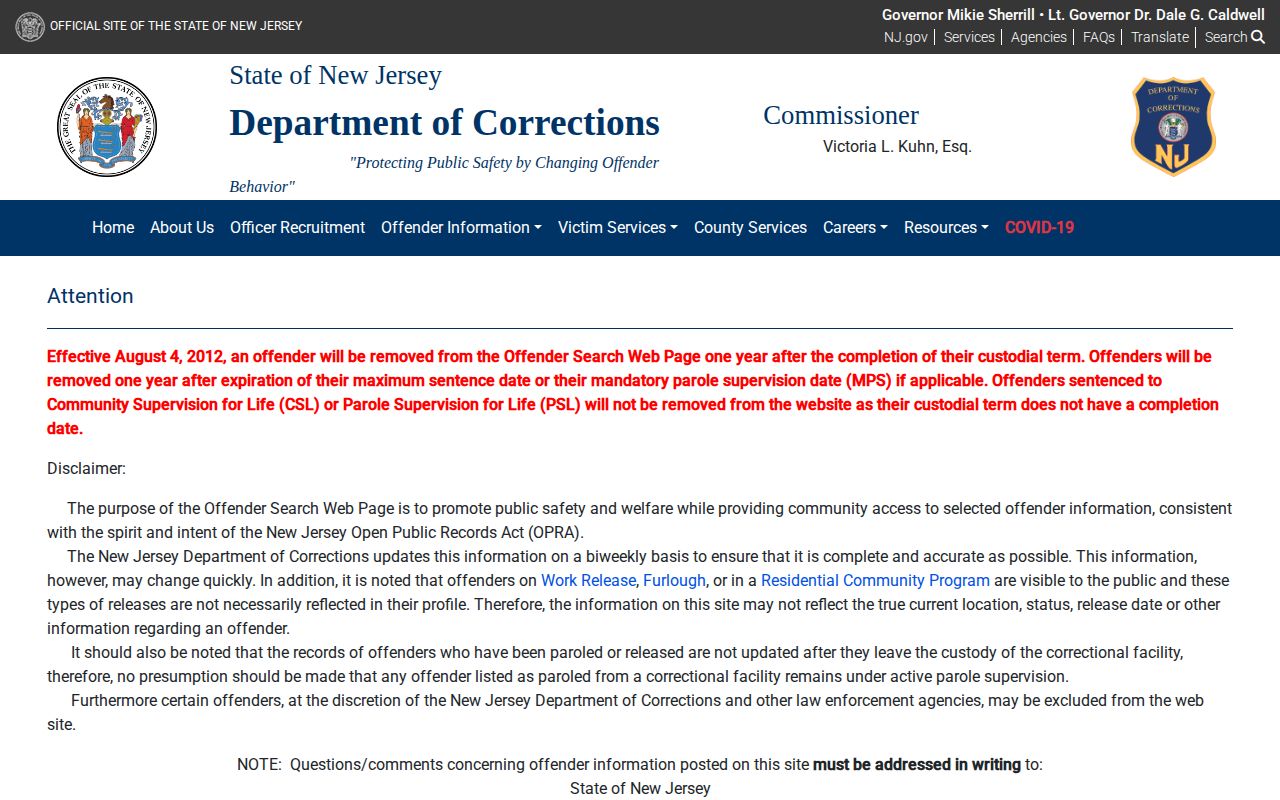
The screen is the starting point, but the profile's custody history supplies the completed-event evidence.
Note: A parole reference in NJDOC does not by itself confirm that parole supervision remains active today.
New Jersey Release Date Labels
NJDOC publishes three date labels that answer different questions. Current Max Release Date is the most recent calculated release date after days earned off and days added because of negative institutional conduct. The agency warns that it can change at the end of each month. Current Parole Eligibility Date is the most recent expected release date under New Jersey State Parole Board calculation policy. Eligibility means a person can be considered under the applicable rules. It is not a grant or a completed release.
Date Out-of-Custody is the historical event field. NJDOC defines it as the date released from custody. This is the field to use when checking whether a specific state custody segment ended. Preserve the label, note the date of the query, and do not restate a current maximum date as “released on.” The separate Inmate Release Date coverage explains how credits and sentence rules affect the forward-looking calculation.
- Eligibility
- The point at which parole consideration may occur under the governing calculation.
- Release
- The end of the listed physical custody segment, which may lead to supervision or another authority.
- Discharge
- The later end of correctional or supervision jurisdiction, shown by final agency proof.
- Detainer
- A hold or request that can change the authority receiving the person after one custody ends.
New Jersey Release Pathways
Several events are often called release, but their legal effects differ. A person may leave prison on parole before the maximum term and remain under State Parole Board conditions. A qualifying case may follow the administrative parole release framework created by the Earn Your Way Out Act. Certain sentences lead to mandatory supervision after the prison portion. A person may instead reach the end of the sentence and receive final discharge from corrections or parole jurisdiction.
The ordinary parole structure appears in N.J.S.A. 30:4-123.51. The Earn Your Way Out Act added administrative parole release and compliance credits within its own eligibility and review rules. For covered violent crimes, the No Early Release Act requires service of 85 percent of the imposed sentence before parole eligibility and includes mandatory supervision after release. That percentage does not apply to every New Jersey sentence.
| Event | Physical Custody | What May Follow |
|---|---|---|
| Parole release | The prison custody segment ends. | State Parole Board supervision and conditions. |
| Administrative parole release | Release occurs through the statutory process. | Applicable parole oversight and compliance rules. |
| Mandatory release | The confinement phase ends at the calculated point. | A required supervision period may follow. |
| Sentence discharge | The completed custody history remains the key record. | Final proof should show jurisdiction has ended. |
| Transfer | One agency's custody ends. | Another jail, NJDOC, BOP, or ICE custody may begin. |
New Jersey Release Scale
The 2024 Vocational Training Planning Board report gives a recent statewide measure. It says the NJDOC incarcerated population had stayed at about 13,000 during the prior three years and that approximately 5,700 people were released in calendar year 2024. The period and qualifier matter. This is an approximate NJDOC figure, not a total for all New Jersey county jails.
Parole counts answer a different question. The State Parole Board reported 1,552 grants and 1,389 denials by two-member panels in FY2024, along with other dispositions. Those are decisions, not a count of distinct people who walked out during that fiscal year. Release-cohort outcome reports also study later results for defined groups. They do not verify a release on a given day.
The NJDOC release outcome report index displays the statewide research series.
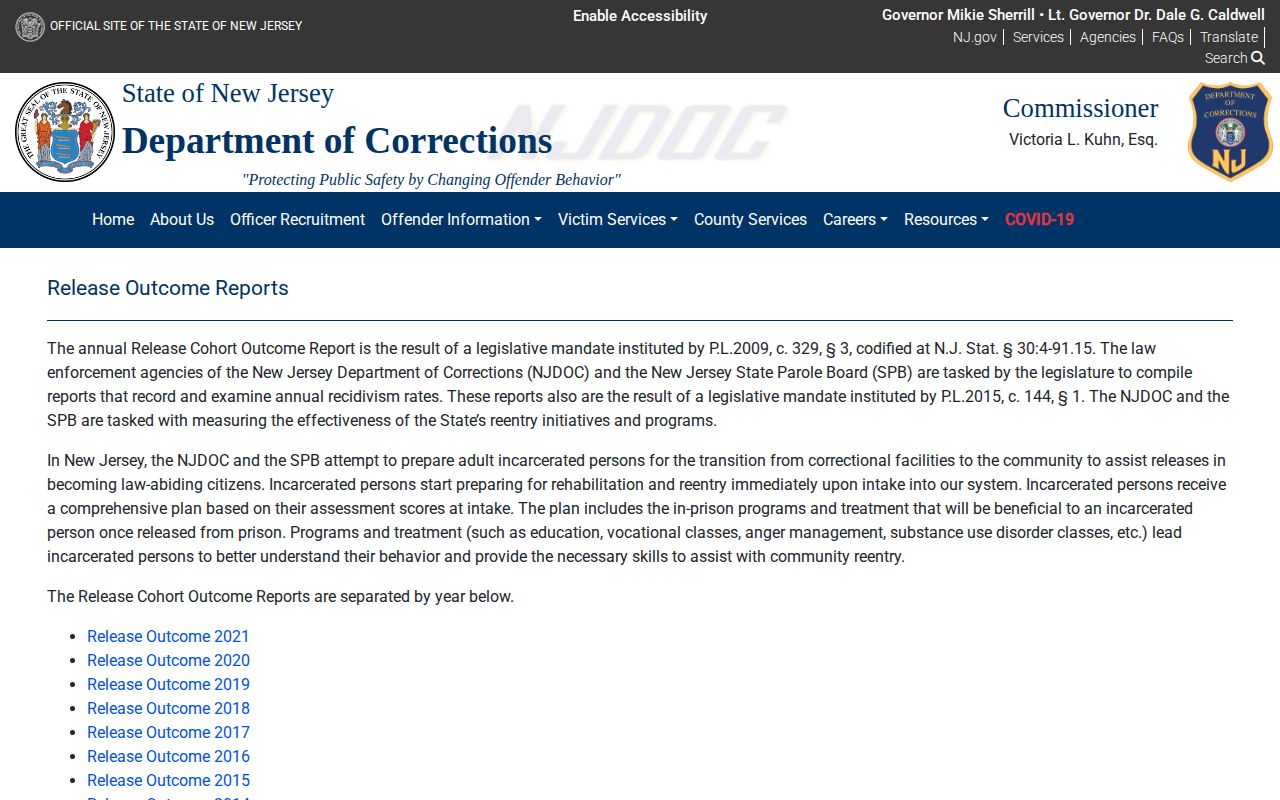
These reports add statewide context, while an individual NJDOC history remains the source for a person's custody dates.
NJDOC Release Record Retention
NJDOC search visibility has a distinctive limit. The Department's published change notice says most records are removed one year after completion of the custodial term. Completion can occur at maximum-sentence expiration or at the end of mandatory parole supervision, as applicable. That means the removal clock does not always begin on the day a person physically leaves an institution.
Community Supervision for Life and Parole Supervision for Life records remain because those custodial terms have no completion date. Two people who left prison on the same day may therefore remain visible for different lengths of time. The legal term controls the retention rule. A missing result is not proof that NJDOC never held or released the person.
If the online entry has been removed, request the maintained movement, release, or final-discharge record. Court records can confirm a judgment or later order, but they do not replace NJDOC's actual custody transaction.
Note: Search visibility and physical custody are separate facts, so neither presence nor absence alone proves current confinement.
New Jersey Release-Day Portfolio
The Fair Release and Reentry Act sets a statewide frame for prerelease planning and help with identification. NJDOC's Office of Programming and Supportive Services gives more detail. Before release, each person is interviewed and offered a chance to buy discounted NJ Transit bus or rail tickets at prices set by NJ Transit. The Department says each releasing person receives a temporary NJDOC photo ID and that eligible people may get help seeking duplicate Social Security cards and birth certificates.
On release day, the person receives a portfolio. Its contents depend on what was obtained and what applies. Possible items include final discharge paperwork, an active warrant or detainer notice, the remaining trust-account balance and final statement, a medical summary, referrals, purchased transit tickets, and identification documents. The Department also describes a two-week medication supply in ordinary cases, while its family guide describes different bridging provisions for designated special-needs cases.
- Temporary NJDOC photo identification
- Final discharge and current-charge papers
- Trust-account balance and final statement
- Medical summary, medication, and referrals
- Applicable identity and transit documents
- Parole reporting or certificate material
No reviewed official source promises universal cash gate money. The documented financial item is the person's own remaining trust-account balance. Confirm the exact portfolio, travel plan, and reporting directions from the institution and final papers.
New Jersey Discharge Proof
Physical release and legal discharge are separate. A Date Out-of-Custody may coexist with parole, No Early Release Act mandatory supervision, Community Supervision for Life, or Parole Supervision for Life. A record that still appears online does not prove the person is inside a prison. Likewise, an ended prison segment does not prove that all supervision is over.
The clean endpoint is a final State Parole Board certificate or discharge record, or another controlling agency order. The Board's documents route includes certificates and its OPRA form. Ask for the final public record that shows whether supervision ended. Do not infer discharge from a future maximum date, a stale status, or silence in a public search.
The State Parole Board records page provides certificate and records-request routes.
This agency route is stronger than treating an eligibility notice or old search entry as proof of final discharge.
New Jersey RCRP Release Status
A Residential Community Reintegration Program, or RCRP, is community based but remains a correctional placement. NJDOC uses these programs for residential and assessment or treatment settings. Moving from a prison to an RCRP changes the location and level of custody. It does not establish an unconditional end of the sentence.
The same caution applies to a halfway house or a furlough. NJDOC defines a furlough as a temporary authorized absence. Neither term should be restated as final release. Wait for the Date Out-of-Custody tied to the relevant segment, then obtain final discharge evidence when the end of jurisdiction matters.
The NJDOC RCRP page explains the correctional placement framework. State prison and community-placement locations also appear in the statewide facility directory, where their type should be read before interpreting a move.
NJDOC County Release Boundary
The NJDOC offender search covers state corrections records. It does not show every brief stay in a county jail, municipal lockup, federal prison, or immigration facility. A person released after a county pretrial stay may never appear in NJDOC. In that case, the holding county's corrections agency maintains the booking and release transaction.
| Custody Layer | Primary Record Route | Release Evidence |
|---|---|---|
| NJDOC prison | NJDOC offender search and OPRA | Date Out-of-Custody and final agency record |
| County jail | Holding county's custodian | County release or transfer transaction |
| Federal BOP | BOP Inmate Locator and FOIA | Released or Not in BOP Custody status with date |
| Immigration custody | ICE locator and FOIA | ICE record for its own custody episode |
A county release may be a transfer into NJDOC. It can also lead to another county, federal custody, or ICE custody. Follow the actual holding agency for each segment. The County Directory routes a county-jail episode to the locality that holds its release record.
The State Parole Board hearing page shows how parole review differs from physical release.
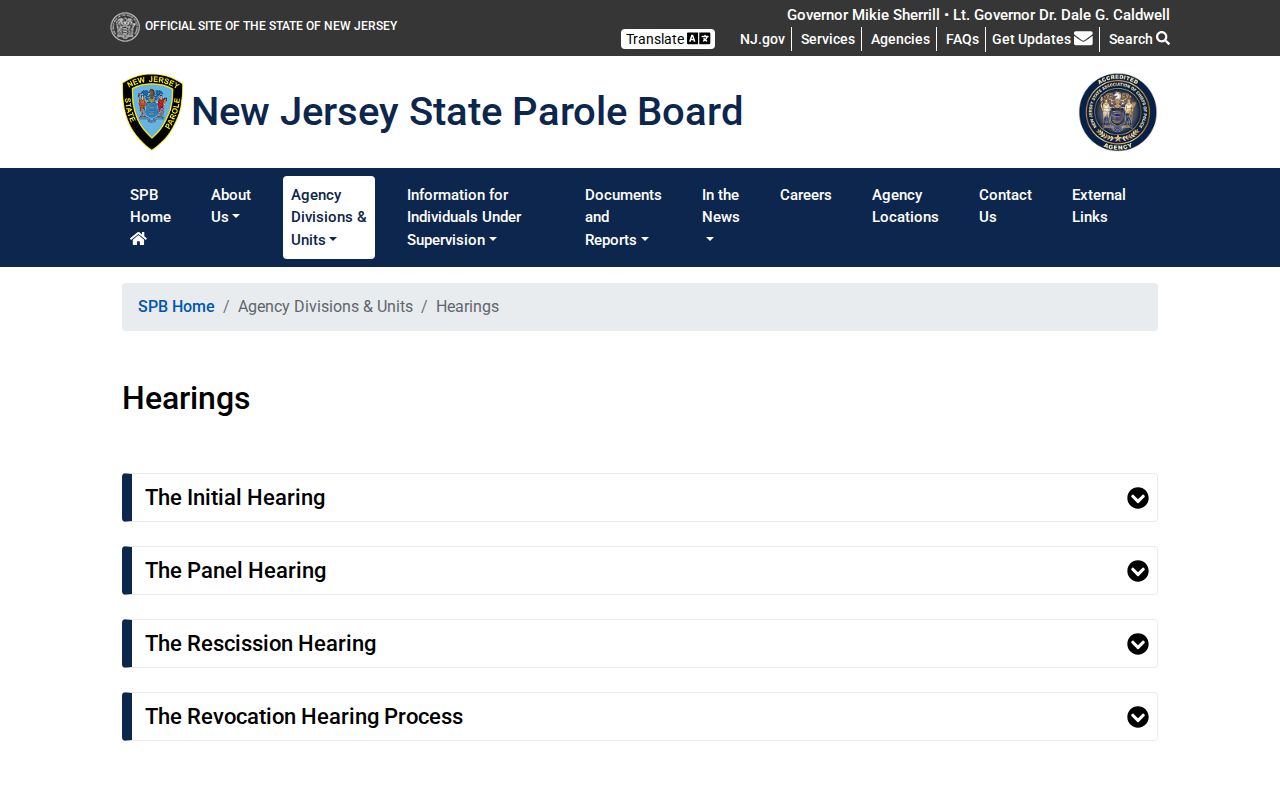
An eligibility review, grant, rescission matter, and completed departure are separate events that need separate proof.
NJDOC Release Records Requests
Use the NJDOC OPRA page or New Jersey OPRA Central and select the Department of Corrections. Ask for an existing record, not an answer to a broad question. Give the full name, SBI number, approximate admission and release period, and county or case identifiers. A narrow request can seek the movement or release transaction, Date In-Custody, Date Out-of-Custody, release or transfer code, receiving-authority category if maintained and public, and final discharge record.
Request electronic delivery and ask that exempt parts be redacted while reasonably separable public portions are released. Avoid seeking medical, victim, security, presentence, risk-assessment, or active investigatory material. OPRA applies to identifiable government records, but it does not make every part of a corrections file public.
- Identify the exact custody episode and SBI number.
- Name the movement, release, or discharge record sought.
- State the approximate date range and case identifiers.
- Ask for electronic records and a fee estimate.
- Preserve any denial, redaction basis, or extension notice.
The Government Records Council says an ordinary complete noncommercial request is generally answered as soon as possible and no later than seven business days, subject to statutory exceptions and valid extensions. Current rules should control because OPRA was amended in 2024. An agency response tied to the right custody segment is the best fallback after a public NJDOC result disappears.