
New Jersey Parole Versus Probation
Parole follows release from a custodial sentence and is supervised by the New Jersey State Parole Board. Probation is imposed through a court case and is administered by the New Jersey Judiciary. Both may place conditions on a person, but they arise from different legal records. The distinction controls where a status inquiry belongs. NJDOC custody history and State Parole Board records support a parole check. A court judgment, later docket entries, and the correct county Probation Division support a probation check.
Physical release does not end every form of authority. NJDOC defines Date Out-of-Custody as the date a person left custody for a listed incarceration segment. That field can exist while parole or another form of mandatory supervision continues. A probation judgment also can remain in force after a county jail term has ended. The final question is therefore not just whether someone walked out. It is whether the agency or court has entered a discharge, termination, expiration, or later order that closes supervision.
| Point | Parole | Probation |
|---|---|---|
| Supervising authority | New Jersey State Parole Board | New Jersey Judiciary through county Probation Divisions |
| Starting record | NJDOC custody history and SPB release or decision record | Criminal judgment and later court docket |
| Open name search | No verified public statewide current-status name search | No verified public statewide probationer name search |
| Best ending proof | SPB discharge certificate or final agency record | Judiciary order or docket showing termination |
The weekly SPB eligibility notices do not answer whether a released person is now supervised. They show possible future consideration and comment timing. That difference keeps an eligibility listing from being mistaken for a present parole record.
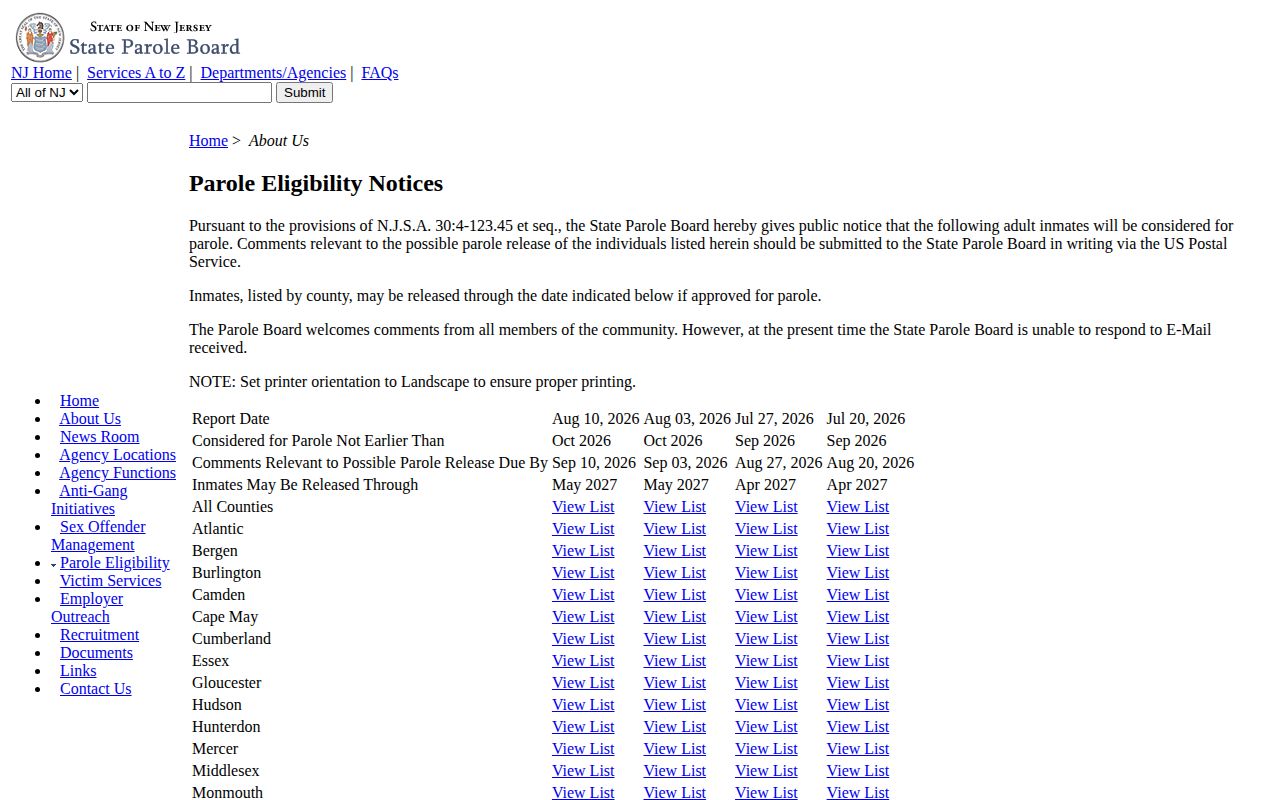
The notice index is useful at the hearing stage, but current supervision still must be checked through the Board's contact and records routes.
Verify New Jersey Post-Release Supervision
Begin with the custody and sentence source. A state-prison record points toward NJDOC and the State Parole Board. A court disposition imposing probation points toward the Judiciary and the county tied to the case. County jail release alone cannot settle the issue because a person might leave local custody for NJDOC, a different authority, probation, or the community. Likewise, NJDOC's public search warns that its information updates on a schedule and is not proof of active parole status after release.
- Match the person with full name, SBI number when known, and enough case detail to avoid a same-name error.
- Read the NJDOC custody segment for Date Out-of-Custody and note any release wording without treating it as final discharge.
- For possible parole, use the State Parole Board district-office route and ask only for publicly releasable present status and the proper district.
- For possible probation, locate the newest Superior Court or municipal disposition, then route the question to the relevant county Probation Division.
- Ask for the latest discharge certificate, termination order, or other existing record that proves supervision ended.
The NJDOC offender search is a strong first layer for a former state prisoner. Its custody timeline can distinguish a current institution record from an older completed segment. It does not replace a direct State Parole Board confirmation.
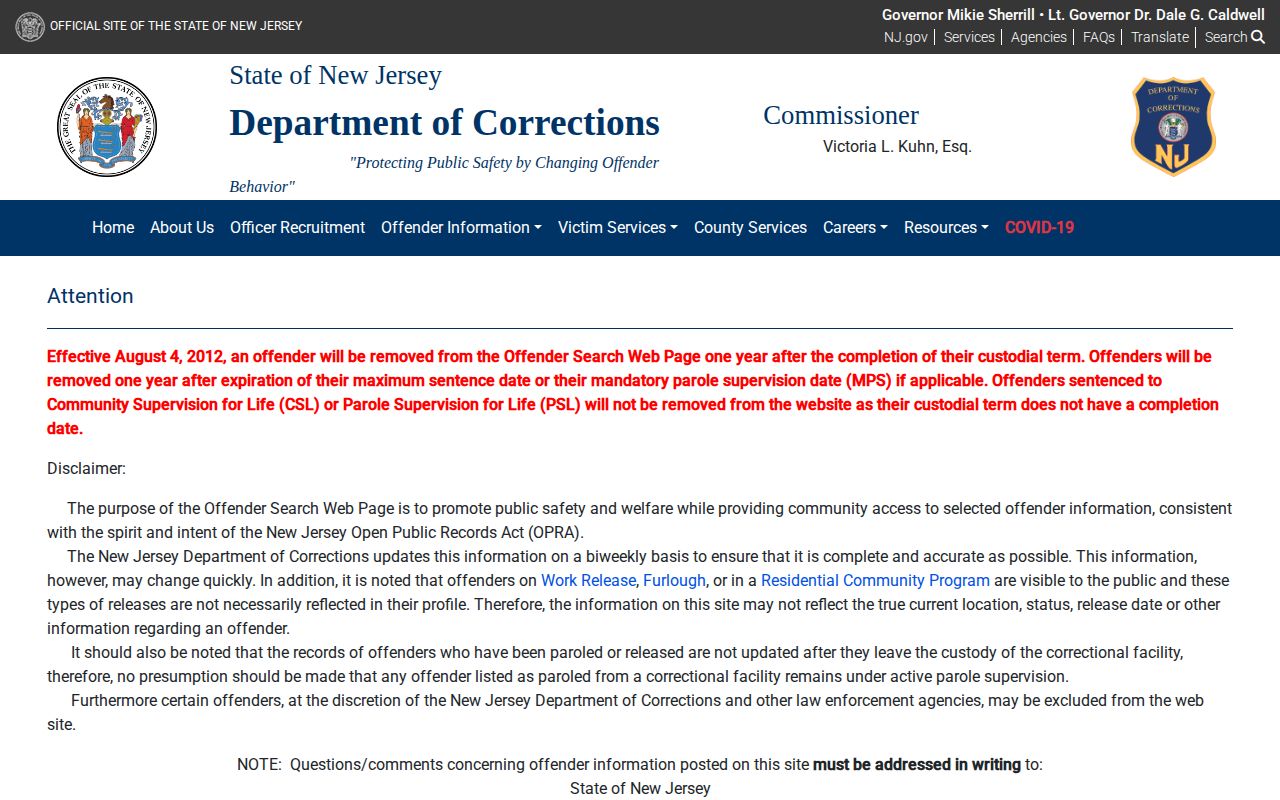
Keep the exact labels shown in the NJDOC result, especially Date Out-of-Custody, rather than turning a calculated date into an event.
Note: A live jail roster shows present local custody and usually cannot verify a person after the release transaction has closed.
New Jersey Parole Agency Contacts
The New Jersey State Parole Board organizes supervision through district offices and specialized statewide units. Its district appendix covers all counties, so a public inquiry can be routed without assuming that the county of conviction, last prison, and supervising district are identical. Ask the central or district contact to confirm which office handles the matter. Do not request a home address, private case plan, victim information, risk material, or other protected details.
Parole authority: New Jersey State Parole Board
District offices and agency contacts
Certificates, reports, and OPRA materials
Probation follows a separate statewide structure. The Judiciary publishes a county Probation Division contact directory. The public route starts with the sentencing county or the court now handling the case. The Probation Client Portal is for authorized clients and their own information, not a general public directory. A caller seeking an existing public record should identify the case and ask what can be released through the court or records process.
These agencies answer different questions. SPB can route parole supervision and discharge matters. A county Probation Division can route a probation case. NJDOC maintains state custody history. The sentencing court supplies the judgment and later orders. Using one agency's silence to draw a conclusion about another agency produces weak results.
New Jersey Supervision Record Terms
Agency terms mark distinct stages. They should be quoted as written because a small change in wording can shift a case from planned release to completed release, or from active supervision to final discharge.
- Parole
- Release from confinement under State Parole Board supervision before the applicable custodial term has fully ended.
- Probation
- A court-ordered form of supervision administered by the Judiciary rather than the State Parole Board.
- Absconder
- A supervision term for a person alleged to have stopped reporting or otherwise left required oversight. It does not itself prove a current warrant.
- Revocation
- A formal decision that ends continuation on parole and can return a person to custody after the required proceedings.
- Discharge
- The legal endpoint shown by the responsible agency's certificate, order, or final record, not merely departure from a facility.
The SPB hearing process shows why these stages matter. It separates initial review, panel action, rescission before release, and revocation after release.
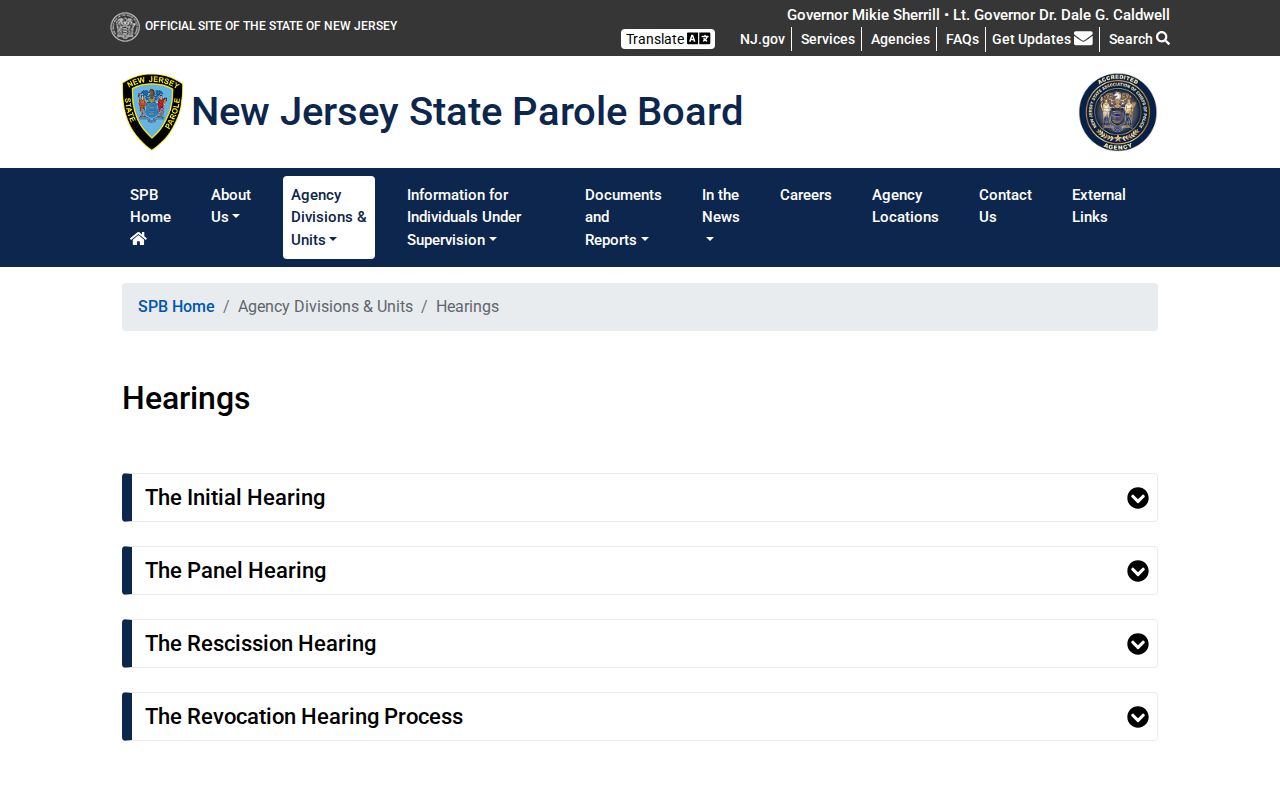
A supervision record should name the stage and date instead of reducing the whole sequence to the single word parole.
New Jersey Parole Violations and Warrants
No comprehensive official statewide public name-searchable parole-absconder list was verified in the New Jersey research. The State Parole Board has a Fugitive Unit and works with other authorities, but an old press item or wanted notice may remain online after facts change. An allegation of absconding, a supervision violation, an issued warrant, a probable-cause finding, and a final revocation are separate facts. Each needs a current source.
Supervision conditions come from the controlling release decision, certificate, court order, and later agency directions. Do not infer a specific condition from the supervision label alone. If a condition matters to verification, seek the current public order or certificate and accept lawful redaction of protected case details. A reported breach is still an allegation until the required process produces a finding. The final dated order controls the outcome.
For a parole matter, the Board's hearing system includes probable-cause and final revocation proceedings. Its fiscal-year report recorded aggregate outcomes, but those totals are not a person-level lookup. In that report, some people were continued on parole while others were revoked. A person-specific statement therefore needs the final order or current agency response. For probation, check the latest court docket and order because a violation can lead to continuation, change, revocation, or a later disposition.
A sound check asks a narrow question: does a current public agency or court record show an active warrant or a final violation decision for the matched person? If the answer is unavailable, state that limit. Do not convert an old allegation into present status. The SPB annual report explains the units and statewide process, while the issuing agency or court controls the live case record.
Note: A custody return after an alleged violation is a new event and should be matched to its own admission and decision records.
New Jersey Supervision Search Limits
New Jersey does not provide one open portal that reliably answers whether any named person is currently on parole or probation. NJDOC search results can show a custody history, and SPB publishes weekly eligibility notices. Neither source is a universal current supervision list. The Judiciary's client portal requires authorized access, while its public criminal portals show court cases and dispositions rather than a full statewide roster of probation clients.
Use the Promis/Gavel public access system for Superior Court criminal matters. Municipal matters use a different court portal. Read the most recent judgment and later docket events, then ask the relevant office about publicly releasable status. A judgment that once imposed probation does not prove the term remains active. It may have expired, moved, ended early, been violated, or changed through a later order.
A no-result needs the same care. NJDOC records generally leave public search after the custodial term is complete, subject to the agency's published rules. Sealed, expunged, juvenile, and otherwise restricted court matters also may not appear. Missing public data can reflect scope, retention, access limits, or a different agency. It is not proof that no custody or supervision event occurred.
New Jersey Parole Discharge Paperwork
New Jersey treats physical release and legal discharge as different milestones. A Date Out-of-Custody can coexist with discretionary parole, administrative parole release, No Early Release Act mandatory supervision, Community Supervision for Life, or Parole Supervision for Life. The NJDOC search-removal notice makes this visible. CSL and PSL records remain because the related custodial terms do not have a completion date, while most other records are removed after the published retention period tied to completion.
The best endpoint for parole is the final SPB certificate or discharge record. The Board's documents area includes certificate materials and an OPRA route. Ask for the existing final record for the matched person and custody episode, if publicly disclosable. For probation, use the sentencing court and county Probation Division to locate the latest order or docket entry showing termination. An institution release sheet does not substitute for either ending record.
The SPB documents and reports page is the official starting point for certificates and records access.
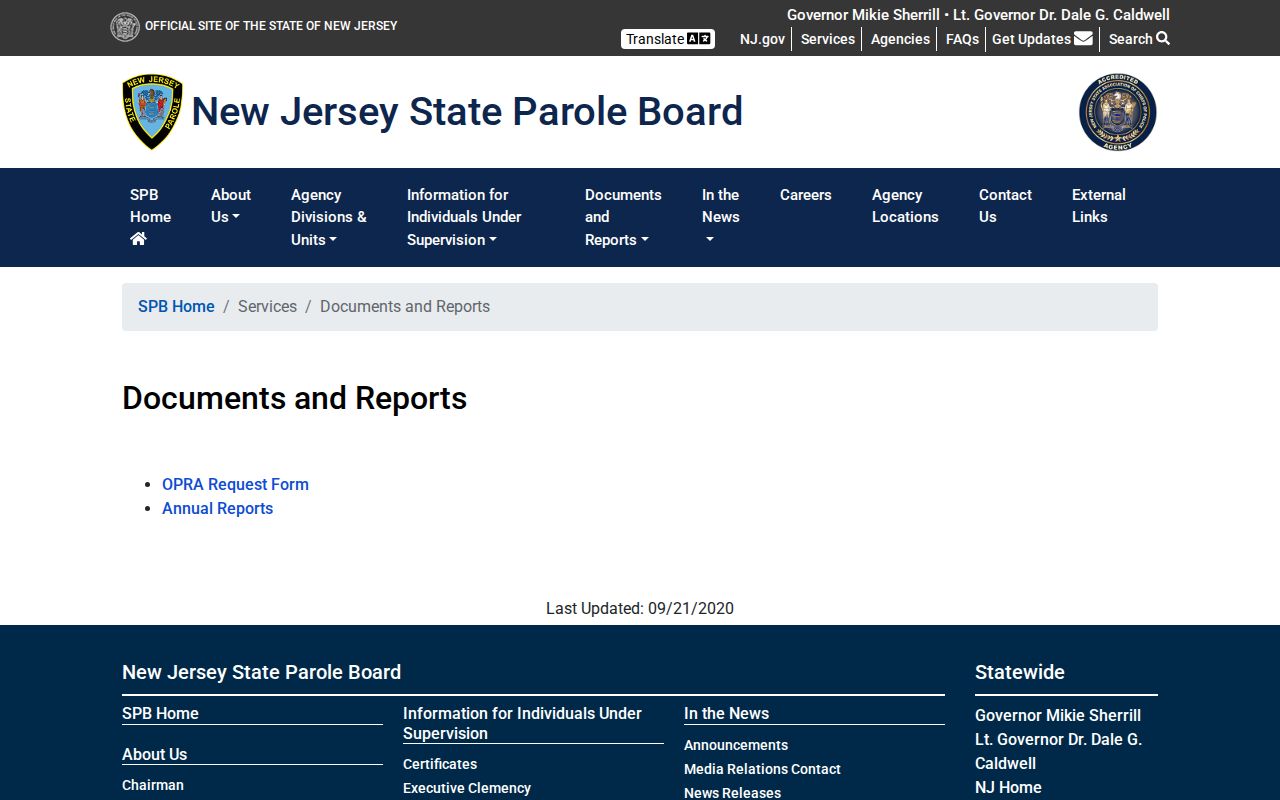
This official route is more reliable than a stale web mention because the request can identify the exact decision, discharge, or certificate sought.
Confirm New Jersey Supervision Discharge
Close the check by comparing four dates and records where they exist: the physical Date Out-of-Custody, the parole or probation start record, the latest status or violation order, and the final discharge or termination record. A mismatch should be described, not forced into one date. This is especially important when a person moved from county custody to NJDOC before entering supervision, or when a court case changed after release.
The statewide New Jersey released inmates search path can help identify the original custody layer before the supervision check begins. For hearing-stage facts, the Parole Board Hearings coverage separates eligibility notices from actual decisions. Once the right authority is known, request only the smallest existing public record that answers the open question.
A careful conclusion uses restrained wording. “Released from NJDOC on the listed Date Out-of-Custody and later discharged by SPB on the certificate date” is far stronger than “off parole” based on a missing search result. For probation, cite the newest Judiciary order. If final proof is not available, identify the record checked, its date, and the limit that remains.